Showing posts with label Peter Jacobi. Show all posts

Tuesday, April 2, 2024

More inspiration for beginners: And then I remembered the weevils . . . .


“I didn’t know you had these pictures, Mom!”


Matt’s face beamed. He grinned his biggest grin, spellbound by the photos he held in his hands.


Hushed, he studied one snapshot after another.


“These will be great, Mom, to show my girls the people and places I’ve been telling them about all these years.”


Matt was talking about pictures I took in South America when he was age six through nine and our family lived in a remote mission center at the end of the road in the middle of nowhere. 


Because of Matt’s delight in discovering those old pictures, I scanned old slides by the hundreds, getting prints, scrapbooking them, and placing them in three-ring binders among written stories from those years. (And eventually, I wrote a memoir, Please, God, Don’t Make Me Go: A Foot-Dragger’s Memoir.)


What are the takeaways for you?


Point #1: Include photos with your memoirs. Your children and grandchildren will be at least as delighted as my Matt was to see our old photos.


Point #2: Photos can help you discover, and then add, detail and richness and depth and breadth to your memoir—and those are important ingredients for (a) capturing readers’ interests and (b) helping them live your stories with you. 


Readers can get inside your stories when you recreate them through the five senses—sight, sound, taste, touch, and smell. Photos can help you do that. (Remember Peter Jacobi’s words, “No story has a divine right to be read.”)


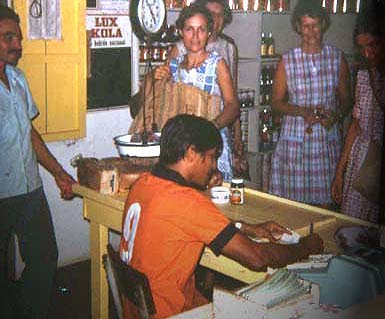
For example, here are two photos of the little commissary at our mission center in South America. That's me in the red shirt. (Oh, my, I was much younger then. And slenderer.  Sigh . . . .)


When I stumbled upon those pictures many years later, I remembered the commissary’s smells: ripe, tropical fruit. Powdered laundry detergent. Broccoli. And rancid bread—if the bread man had come.


And then I remembered the burlap bags. Since we had no paper bags, one of our options was to lug groceries home in colorful locally-made burlap totes. They were coarse and scratchy and had a dried-grass-burlap-ish smell.


And then I remembered the flour I bought at the commissary, hand-scooped (by someone, somewhere—I probably didn’t want to know the specifics) into tiny little plastic bags, usually a bit grimy. 


And then I remembered the weevils that lived in that flour.


And then I remembered that at first, I didn’t know what to do about the weevils. I must have led a very sheltered life because I didn’t even know what weevils were, let alone that they could live in flour.


When I first arrived at the mission center, no one taught me that I could (a) put the flour in the freezer and freeze those little critters to death, or (b) spread the flour on a cookie sheet and bake them to death. Then all I had to do was sift out their lifeless little bodies.


And then I remembered that before I knew how to murder weevils, I fed them to a big crowd. I was asked to bring cinnamon roles to an event and, you guessed it—they were speckled inside with little black, crunchy dots—dead weevils. (You can read more in my memoir, Please, God, Don’t Make Me Go: A Foot-Dragger’s Memoir.)


See what I mean about the value of photos? I knew those stories—but I had forgotten them. I needed to rediscover them. Taking another look at those photos did that for me. And then I could include them and their stories in my memoir.


Sharon Lippincott, too, knows the value and joy of old photos. Reading her "Photographic Memory Jolts" was pure enjoyment for me. From only one photo, she listed dozens of memories.


Take, for example, Sharon’s memories of saddle oxfords. Her post reminded me that every morning before school, I spent a lot of time polishing my own saddle shoes—the white part and the black part.


And I’d forgotten all about my Ivy League saddle shoes with the oh-so-cool little buckle in the back.


And then there was Sharon’s memory of Natalie Wood using Scotch Tape to keep her bangs in place while they dried. Yes, I did that too.


Sharon’s post is a fun read, a treasure trove of history especially if you’re around my age—and all from just one photo!


How about you? Pull out an old photo related to one of the stories in your memoir.


  • What emotions does it stir up?
  • What songs were popular at that time?
  • What styles of clothing, eyeglasses, hairstyles, shoes, furniture, and architecture does the photo capture?
  • Does the photo raise questions?
  • What happened just before the photo was taken? Just afterward?
  • Was something significant brewing at the time, even if you didn’t know it until later?
  • In later years, what happened to the people in the photo?
  • Does it remind you of additional stories?


Go beyond looking at your old photos. What smells come to mind? Textures? Sounds? Tastes? Sights?


Listen. Smell. Feel. Taste. 


Relive. 


Unravel.


I have a hunch you’ll discover details 

that will add gusto to your stories.


Have fun!


Tuesday, February 20, 2024

Especially for wordsmiths, ink-slingers, and painters of words


If you’re a wordsmith—an ink-slinger, a painter of words—I suspect you’ve been enjoying our lessons on the crafting of sentences.


We started by looking at short sentences and sentence fragments—they offer impact and punch. (Click on “Sentences are a little like purses” if you missed it.)


Next, we looked at using long sentences in your memoir. (Click on "The beauty of long sentences.")


Today we’ll continue with long sentences. They can be very effective, but writers must be cautious because “Most of us aren’t terribly good at writing good, long sentences,” according to one of my favorite teachers, Peter Jacobi.


“If we write not-so-good long sentences for not-so-good readers,” he says, “confusion sets in—fast. The reader forgets by midsentence what the root of the sentence was about.” (The Magazine Article)


Here are today’s tips for writing long sentences:


To test for clarity—or lack of it—in any sentence longer than three typed lines, Joseph F. Williams suggests you read it aloud. (I suggest that you also use your computer’s “Read Aloud” feature.)


Joseph’s paragraph, below, will leave you with a smile:


“If the process of reading one of your own long sentences

gives you the feeling that you are about to run out of breath

before you come to a place where you can pause

in order to integrate all of the parts of the sentence

to get a sense of how its whole fits together

to communicate a single conceptual structure,

you have identified a sentence

that your readers are likely to wish that you had revised.

Like that one.”

(Style: Ten Lessons in Clarity and Grace)


Notice how other people write long sentences. Some don’t work—as Williams so cleverly showed us above—but others do work well.


Here’s an example of a brilliantly crafted sentence. It’s worth your time to linger and savor it:


“Riding down to Port Warwick from Richmond, the train begins to pick up speed on the outskirts of the city, past the tobacco factories with their ever-present haze of acrid, sweetish dust and past the rows of uniformly brown clapboard houses which stretch down the hilly streets for miles, it seems, the hundreds of rooftops all reflecting the pale lights of dawn; past the suburban roads still sluggish and sleepy with early morning traffic, and rattling swiftly now over the bridge which separates the last two hills where in the valley below you can see the James River winding beneath its acid-green crust of scum out beside the chemical plants and more rows of clapboard houses and into the woods beyond.” (from Lie Down in Darkness by William Styron, quoted in Elements of the Writing Craft by Robert Olmstead)


Olmstead helps us analyze Styron’s sentence:


“The weight of the train at ever-increasing speed

[is] evoked in the first line,

and the rest is the landscape

that sweeps past our window.

The images come to us rapidly and clearly

because we are moving so quickly

and because our eye focuses through the window

as if it were the lens of a camera.”


That sentence “mirrors the action of the train,” writes Olmstead, “moving over the page the same way the train moves over the land. What the sentence says and does are the same.”


Olmstead points out how Styron crafted his long sentence (121 words!) so well:


“ . . .  tobacco factories with their ever-present haze . . .

sweetish dust and past the rows . . .

brown clapboard houses which stretch down . . .

for miles, it seems, the hundreds of rooftops all reflecting . . .

roads still sluggish and sleepy with early morning traffic,

and rattling swiftly. . . . ”


Olmstead wants us to notice this about Styron’s sentence:


“The words in italics are simple,

but they make the sentence work.

They are as important to master as the clever turn of phrase.

They are like gristle or cartilage.

They are the stuff between joints and bones

that smoothes the action.

Without them, the setting goes flat.”


Retrieve your rough drafts and look for places long sentences would be effective.


Maybe you, too, have written a vignette about a train ride, or about lifting off a dirt airstrip in a six-seater plane in the jungle—or the desert. (I have.) Have you ever bungee jumped? What other scenes come to your mind—stories in which long sentences, like Styron’s, would work?


Don’t be intimidated: Go ahead and experiment with long sentences because they can add texture and dimension and movement to your writing.


Remember:


“Very few sentences come out right the first time,

or even the second or third time.”

(William Zinsser, Writing About Your Life)


Read them aloud for clarity

and if your experimental sentences don’t work,

keep tweaking them—

or even toss them, just for now.


Most of all, have fun!


Tuesday, March 21, 2023

Back to Basics: Your stories are all around even if you don’t recognize them


Your stories are everywhere, all around you, just waiting for you to put them in writing.


Look at your cell phone contact list, your address book, email inbox, friends on Facebook and other social media. What stories can you write about the fun you had with them? About the adventures? What skills did those people teach you?


Go deeper: What did you learn alongside them about failure, hard work, success, romance, illness, teamwork? What lessons did they teach you?


Think back: Who taught you about honesty, integrity, perseverance, kindness, compassion, generosity, faith in God? How, specifically, did those individuals shape you and encourage you to be the person you are today?


Stories are everywhere—not just stories. God-and-you stories.


 Look around your office or your house. What have you tucked into a special drawer or a safe deposit box?


If a tornado siren sounded, or if a smoke alarm went off, what would you grab and take to a safe place?


If those items could talk, what stories would they tell?


I think about that question a lot.


Someday I want to write stories based on my old blue American Tourister carry-on bag. It traveled with me for thirty years across three continents: from this planet’s most primitive places to the world’s most sophisticated cities. What stories it could tell!


What stories would my husband’s grandmother’s aluminum colander tell? And her ironing board? I don’t know how many years Grandma Jennings used them, but I’ve used them for more than fifty years! Five generations of our family (so far) have used those items. Imagine what stories they could tell—stories of God’s goodness to our family, generation after generation.


Why have you thrown out some possessions 

but kept others for many years?


Why could you never throw them out or give them away? 

Because they represent something important to you. 

What is that something?


Look around and ask yourself:


“If this dining room table could talk, what stories would it tell?”


“If my old Bible could talk, what stories would it tell?”


“If these boots could talk, what stories would they tell?”


What about a photo? A book? Washing machine? Piece of art? Jewelry? Woodworking tools? Coffee mug? Mechanical tools? Art supplies? A vase? A favorite old devotional book?


Many items could tell stories—stories significant to you and your family.


Glenda Bonin suggests we interview key people—and even ourselves.


“Don’t be timid about interviewing yourself and others,” Glenda writes. “A good interviewer asks questions and waits for answers. . . . Listen deeply, allowing as much time as needed for quiet moments of thought. Do not rush in with a new question until you are satisfied that the question has been fully explored. . . . These moments are often where the best family stories can be found. . . .”


I like Glenda’s suggestion: Interview others, yes, but also interview yourself, and “listen deeply, allowing as much time as needed. . . .”


You might even schedule a time to think, to ponder an item’s importance. Or maybe you could contemplate while you drive to work or mow the lawn or walk the dog.


What questions do you need to ask?


What questions do you need to ask yourself?


Peel back layers. 

Wait for answers. Listen for them.


When answers surface, write your stories—

not just stories. Write God-and-you stories.


Remember, while you’ve been using and enjoying those items, God has always been with you, working in you, working on your behalf.


You don’t need to experience news-making miracles to witness God at work. He is in your everyday comings and goings.


As Oswald Chambers says,


“We look for visions from heaven

and for earth-shaking events

to see God’s power. . . .

Yet we never realize that

all the time God is at work

in our everyday events

and in the people around us.”


Write your stories!


Tuesday, August 23, 2022

And then I remembered the weevils that lived in that flour


 “I didn’t know you had these pictures, Mom!”


Matt’s face beamed. He grinned his biggest grin, spellbound by photos he held in his hands.


Hushed, he studied one snapshot after another.


“These will be great, Mom, to show my girls the people and places I’ve been telling them about all these years.”


Matt was talking about pictures I took in South America when he was age six through nine and our family lived in a remote mission center at the end of the road in the middle of nowhere.


Those were formative years for my boy. He experienced adventures most kids in North America couldn’t imagine, and they define the man he is today.


Because of Matt’s delight in discovering those old pictures, I scanned old slides by the hundreds, getting prints, scrapbooking them, and then placing them in three-ring binders among written stories from those years. (I told you about that last week and about the memoir I eventually wrote, Please, God, Don’t Make Me Go: A Foot-Dragger’s Memoir. Click on How one old photo led me to write a memoir.)


What are the takeaways for you?


Point #1: Include photos with your memoirs. Your children and grandchildren will be as delighted as my Matt was in seeing our old photos.


Point #2: Photos can help you discover, and then add, detail and richness and depth and breadth to your memoir—and those are important ingredients for (a) capturing readers’ interests and (b) helping them live your stories with you.


Readers can get inside your stories when you recreate them through the five senses—sight, sound, taste, touch, and smell. Photos can help you do that. (Remember Peter Jacobi’s words, “No story has a divine right to be read.”)


For example, here are two old, old photos of the little commissary at our mission center in South America. I’m wearing the red shirt. (Oh, my, I was much younger then. And slenderer.  Sigh . . . .)


When I stumbled upon those pictures many years later, I remembered the commissary’s smells: ripe, tropical fruit. Powdered laundry detergent. Broccoli. And rancid bread—if the bread man had come.


And then I remembered the burlap bags. Since we had no paper bags, one of our options was to lug groceries home in colorful locally made burlap totes. They were coarse and scratchy and had a dried-grass-burlap-ish smell.


And then I remembered the flour I bought at the commissary, hand-scooped (by someone, somewhere—I probably didn’t want to know the specifics) into tiny little plastic bags, usually a bit grimy.


And then I remembered the weevils that lived in that flour.


And then I remembered that at first, I didn’t know what to do about the weevils. I must have led a very sheltered life because I didn’t even know what weevils were, let alone that they could live in flour.


When I first arrived at the mission center, no one taught me that I could (a) put the flour in the freezer and freeze those little critters to death, or (b) spread the flour on a cookie sheet and bake them to death. Then all I had to do was sift out their lifeless little bodies.


And then I remembered that before I knew how to murder weevils, I fed them to a big crowd. I was asked to bring cinnamon roles to an event and, you guessed it—they were speckled inside with little black, crunchy dots—dead weevils. (You can read more in my memoir, Please, God, Don’t Make Me Go: A Foot-Dragger’s Memoir.)


See what I mean about the value of photos? I knew those stories—but I had forgotten them. I needed to rediscover them. Taking another look at those photos did that for me. And then I could include them and their stories in my memoir.


Sharon Lippincott, too, knows the value and joy of old photos. Reading her PhotographicMemory Jolts was pure enjoyment for me. From only one photo, she listed dozens of memories.


Take, for example, Sharon’s memories of saddle oxfords. Her post reminded me that every morning before school, I spent a lot of time polishing my own saddle shoes—the white part and the black part.


And I’d forgotten all about my Ivy League saddle shoes with the oh-so-cool little buckle on the back.


And then there was Sharon’s memory of Natalie Wood using Scotch Tape to keep her bangs in place while they dried. Yes, I did that too.


Sharon’s post is a fun read, a treasure trove of history especially if you’re around my age—and all from just one photo!


How about you? Pull out an old photo related to one of the stories in your memoir.


  • What emotions does it stir up?
  • What songs were popular at that time?
  • What styles of clothing, eyeglasses, hairstyles, shoes, furniture, and architecture does the photo capture?
  • Does the photo raise questions?
  • What happened just before the photo was taken? Just afterward?
  • Was something significant brewing at the time, even if you didn’t know it until later?
  • In later years, what happened to the people in the photo?
  • Does it remind you of additional stories?


Go beyond looking at your old photos. What smells come to mind? Textures? Sounds? Tastes? Sights?


Listen. Smell. Feel. Taste.


Relive.


Unravel.


I have a hunch you’ll discover details that will add gusto to your stories.


Have fun!


Tuesday, August 18, 2020

Especially for wordsmiths, ink-slingers, and painters of words


If you’re a wordsmith—an ink-slinger, a painter of words—you’ve been enjoying our lessons on the crafting of sentences.

We started by looking at short sentences and sentence fragments—they offer impact and punch. (Click on “Sentences are a little like purses” if you missed it.)

Next, we looked at using long sentences in your memoir. (Click on The beauty of long sentences.)

Today we’ll continue with long sentences. They can be very effective, but writers must be cautious because “Most of us aren’t terribly good at writing good, long sentences,” according to one of my favorite teachers, Peter Jacobi.

“If we write not-so-good long sentences for not-so-good readers,” Jacobi says, “confusion sets in—fast. The reader forgets by midsentence what the root of the sentence was about.” (The Magazine Article)


Here are today's tips for writing long sentences:

To test for clarity—or lack of it—in any sentence longer than three typed lines, Joseph F. Williams suggests you read it aloud. (His paragraph, below, will leave you with a smile.)

“If the process of reading one of your own long sentences gives you the feeling that you are about to run out of breath before you come to a place where you can pause in order to integrate all of the parts of the sentence to get a sense of how its whole fits together to communicate a single conceptual structure, you have identified a sentence that your readers are likely to wish that you had revised. Like that one.” (Style: Ten Lessons in Clarity and Grace)

Notice how other people write long sentences. Some don’t work—as Williams so cleverly showed us above—but others do work well.

Here’s an example of a brilliantly crafted sentence. It’s worth your time to linger and savor it:

“Riding down to Port Warwick from Richmond, the train begins to pick up speed on the outskirts of the city, past the tobacco factories with their ever-present haze of acrid, sweetish dust and past the rows of uniformly brown clapboard houses which stretch down the hilly streets for miles, it seems, the hundreds of rooftops all reflecting the pale lights of dawn; past the suburban roads still sluggish and sleepy with early morning traffic, and rattling swiftly now over the bridge which separates the last two hills where in the valley below you can see the James River winding beneath its acid-green crust of scum out beside the chemical plants and more rows of clapboard houses and into the woods beyond.” (from Lie Down in Darkness by William Styron, quoted in Elements of the Writing Craft by Robert Olmstead)

Olmstead helps us analyze Styron’s sentence:

“The weight of the train at ever-increasing speed [is] evoked in the first line, and the rest is the landscape that sweeps past our window. The images come to us rapidly and clearly because we are moving so quickly and because our eye focuses through the window as if it were the lens of a camera.”

That sentence “mirrors the action of the train,” writes Olmstead, “moving over the page the same way the train moves over the land. What the sentence says and does are the same.”

Olmstead points out how Styron crafted his long sentence (121 words!) so well: “ . . .  tobacco factories with their ever-present haze . . . sweetish dust and past the rows . . . brown clapboard houses which stretch down . . . for miles, it seems, the hundreds of rooftops all reflecting . . . roads still sluggish and sleepy with early morning traffic, and rattling swiftly. . . . ” and so on.

Here’s what Olmstead wants us to notice about Styron's sentence: “The words in italics are simple, but they make the sentence work. They are as important to master as the clever turn of phrase. They are like gristle or cartilage. They are the stuff between joints and bones that smoothes the action. Without them, the setting goes flat.”


Here's your assignment for this week: Retrieve your rough drafts and look for places long sentences would be effective.

Maybe you, too, have written a vignette about a train ride, or about lifting off a dirt airstrip in a six-seater plane in the jungle—or the desert. (I have.) Have you ever bungee jumped? What other scenes come to your mind—stories in which long sentences, like Styron’s, would work?

Don’t be intimidated: go ahead and experiment with long sentences because they can add texture and dimension and movement your writing.

Remember: “Very few sentences come out right the first time, 

or even the second or third time.” 

William Zinsser, Writing About Your Life) 

Read them aloud for clarity 

and if your experimental sentences don’t work, 

keep tweaking them—or even toss them, just for now.

Most of all, have fun!


Thursday, September 28, 2017

Will your memoir be intriguing enough?


You know your stories are important. (If you’re not convinced, look at that Bible verse way up at the top, and go back and read Are your stories important?) 

You have God-and-you stories that only you can tell, and your children and grandchildren need to know them. Perhaps friends, colleagues, and even strangers need to know them, too.

Yes, your stories are important. But will anyone read them?

Nowadays potential readers have many distractions: texting, Facebook, cell phones, movies, sports, TV, magazines, iPods, the internet, hobbies, and thousands of books besides yours.

All these, and more, compete against your memoir.

And to make matters worse, in Tuesday’s post we covered some startling, even discouraging, statistics: …..


  • “The average time spent reading is on the decline…. On average, Americans read only 19 minutes per day, down from 10 years ago…. On weekends, Americans between the ages of 25 to 34 read for just eight minutes a day on average.”
  • “Most people read only part of a nonfiction book. In fact, a study by Kobo found that religion books were the most abandoned of any genre. In North America, only a little over one-third of all religion books are read all the way to completion.”

Does that make you gulp? It does me.

Peter Jacobi wrote one brief sentence 25 years ago that I’ve always remembered:

“No story has a divine right to be read.”


“Unfortunately, as a writer . . . I cannot try what author Anthony Burgess did when he was ‘teaching Shakespeare at City College . . . at 8:00 a.m.’ He explains, ‘I decided to teach them something about how Shakespeare was educated. I began to write three lines of Seneca in Latin on the blackboard to show where Shakespeare learned about rhythm, and they started to walk out. Well, I wasn’t going to let them get away. I rushed to the door and locked it, saying, “You’re going to learn these . . . lines of Latin whether you like it or not.”’” 

We can’t lock our “audience” in and force them to read our stories.

Because attention spans are short and schedules are packed nowadays, people will spend time on only what promises to be worth their effort.

That means our stories must be more intriguing than all those distractions and choices before them.

Think of your own experience: How many times have you started reading a book or magazine or newspaper or blog post, anticipating—maybe even craving—a good read, only to be disappointed with boring or confusing content?

Here’s the lesson you and I can learn from such an experience: Our memoirs must draw readers in and keep them turning the pages.

“Some writers assume
readers are eager to grasp every word they write.
The opposite is true . . . .
Because we find it interesting,
or we think our life is newsworthy,
it’s easy to assume everyone cares.
It’s better to assume no one cares
about what we write . . . .”

Ouch!

So we memoirists must write stories worth reading.

We must earn the right to be read—we must capture the reader’s interest so he’ll keep reading all the way to the end.

How do we write stories worth reading? We find answers to that question in books and articles and writers’ conferences and blog posts.

And from week to week, I post the best of those tips here at Spiritual Memoirs 101—and I post even more valuable info on Facebook. (If you’re not following us on Facebook, you’re missing a lot!)

The links below will connect you to two of the main ways we can hook readers and keep them reading. These merely scratch the surface, but here is a sampling:

The first link will take you to last week’s post: We examined a memoir that lacked emotional depth because the author failed to let readers into her emotions and thoughts and reactions. As a result, she remained a one-dimensional person.

You and I can avoid her mistake by describing how we feel during key scenes and letting readers inside. Read more about creating emotional depth in your memoir by clicking on Performing emotional surgery on ourselves. 

The second link will help you recreate scenes through the five senses—sight, sound, taste, touch, and smell. When we include sensory details, readers enter into our stories—they live them with us—and that keeps them reading.

You’ll find this post especially helpful: Details: A must for your memoir. Don’t miss it!


Thursday, March 16, 2017

Your stories: Where do you find them?


Your stories are all around you, just waiting for you to put them in writing.

Look at your cell phone contact list, your address book, your Facebook friends, your email inbox, your Twitter friends—what stories can you write about some of those people?

What stories can you write about the fun you had with them? About the adventures? What did you learn alongside them about failure, hard work, success, romance, illness, teamwork?

What skills did those people teach you?

What lessons did they teach you?

Who taught you about honesty, integrity, perseverance, kindness, compassion, generosity, faith in God? How, specifically, did those individuals shape you and encourage you to be the person you are today?

Write your stories! But not just stories. God-and-you stories.

Stories are everywhere. Look around your office or your house. What have you tucked into a special drawer or a safe deposit box?

If a tornado siren sounded, or if a smoke alarm went off, what would you grab and take to a safe place?

If those items could talk, what stories would they tell?

I think about that question a lot.

Someday I want to write stories based on my old blue American Tourister carry-on bag (a gift from Schiefelbeins before Dave and I left for Africa; thanks, Rick and Marilyn!). It has traveled with me for 24 years and counting, across three continents: from this planet’s most primitive places to the world’s most sophisticated cities—and what stories it could tell! Not just stories, but God-and-me stories.

What stories would my husband’s grandmother’s aluminum colander tell? And her ironing board? I don’t know how many years Grandma Jennings used them, but I’ve used them for 50 years! Five generations of our family (so far) have used those items. Imagine what stories they could tell—stories of God’s faithfulness to our family, generation after generation.

Why have you thrown out some possessions but kept others for many years?

Why could you never throw them out or give them away? Because they represent something important to you. What is that something?

Look around and ask yourself:

“If this dining room table could talk, what stories would it tell?”

“If my old Bible could talk, what stories would it tell?”

“If these boots could talk, what stories would they tell?”

What about a photo? A book? Washing machine? Piece of art? Jewelry? Woodworking tools? Coffee mug? Mechanical tools? Art supplies? A vase? A favorite old devotional book?

Many items could tell stories—stories significant to you and your family.

Set aside time to think about a key item. Ponder its importance: while you drive to work or mow the lawn or brush your teeth or walk the dog or drive the grandkids to baseball practice.

Look at old photos connected with the item—photos of places and people.

What questions do you need to ask?

What questions do you need to ask yourself?

Peel back layers. Wait for answers. Listen for them.

When answers surface, write your stories—not just stories. Write God-and-you stories.

Remember, while you’ve been using and enjoying those items, God has always been with you, working in you, working on your behalf.

Your stories are all around you. You don’t need to experience news-making miracles to witness God at work. He is in your everyday comings and goings.

Oswald Chambers says it this way:

“We look for visions from heaven
and for earth-shaking events
to see God’s power.
Yet we never realize that
all the time God is at work
in our everyday events….”


Write your stories!


Thursday, February 20, 2014

Sprinkle gold coins in the middle

Your stories are important. But will anyone read them? All the way through? A few gold nuggets could make it happen.

Your potential readers have countless distractions and they all compete with your memoir.

Just think of it: the Internet, iPhones, movies, athletics, TV, hobbies, texting, exercising, magazines, Twitter, Facebook, friends, chores, other people’s books—and more.

Twenty-some years ago, I read one brief sentence I’ve always remembered:

(Peter Jacobi)

You cannot force anyone to read your stories, no matter how important they are. 

You know what it’s like to sit down with a book or magazine anticipating—even craving—a good read, only to be bored.

And you know very well that story does not have a divine right to be read. You feel no hesitation in dropping it and looking for something better to read.

You don’t want readers to do that with your stories. What can you do?

First, hook them with a killer lead.

Throughout your manuscript, make ‘em laugh, cry, and wait.

Your stories are important. To keep readers reading, pay special attention to the middle of your stories.

Keep them reading by “placing gold coins along the path.”

Don Fry coined that phrase. It goes something like this:

Picture yourself making your way down a narrow path in a thick forest. (I’m picturing one with tangled, soggy underbrush in western Washington’s rain forest.) You’ve been hiking a mile when you spot a gold coin on the ground. You snatch it up and put it in your pocket. You trek a mile deeper into the woods, find another gold coin, and slip it into your pocket. Think about it: Would you keep traipsing through the forest, hoping for another gold coin? Sure! Most of us would hike another mile for another gold coin. (from Writing Tools, Roy Peter Clark)

“Think of a gold coin as any bit that rewards the reader,” says Roy Peter Clark, a master teacher of writing and one of my favorite mentors for decades.

“With no gold coins for motivation, the reader may drift out of the forest.”

Don’t let them drift out of your forest!

Don’t let their interest fade! Scatter gold coins especially in the middle of your stories!

Even the old Bard himself, Shakespeare, gave out gold coins in the middle of his plays.

Clark offers these ideas for developing “dramatic and comic high points,” gold coins to drop within your stories:

  • a small scene (the setting)
  • a relevant anecdote
  • a startling fact
  • a significant quotation

I can think of other ideas:

  • a quirky anecdote
  • a little-known fact
  • an intriguing historical fact
  • foreshadowing an important twist or turning point or crossroads in your story
  • raising a question
  • Can you think of others? Leave your ideas in the comments section below.

In his Writing Tools: 50 essential strategies for every writer, Clark offers practical recommendations:

  • Study other people’s writing and movies for strategic placement of gold coins.
  • If you’re doing research for your stories, recognize gold coins when you stumble upon them and be sure to use them in your stories.
  • Examine one of your rough drafts and notice gold coins—“any story element that shines”—and mark them with a star. Note their placement. Are they in the best place?
  • Study the middle of your story. Does it include significant gold coins—rewards for your readers? If not, write in some nuggets or move them from other parts of your manuscript.