Showing posts with label Sharon Lippincott. Show all posts

Tuesday, April 2, 2024

More inspiration for beginners: And then I remembered the weevils . . . .


“I didn’t know you had these pictures, Mom!”


Matt’s face beamed. He grinned his biggest grin, spellbound by the photos he held in his hands.


Hushed, he studied one snapshot after another.


“These will be great, Mom, to show my girls the people and places I’ve been telling them about all these years.”


Matt was talking about pictures I took in South America when he was age six through nine and our family lived in a remote mission center at the end of the road in the middle of nowhere. 


Because of Matt’s delight in discovering those old pictures, I scanned old slides by the hundreds, getting prints, scrapbooking them, and placing them in three-ring binders among written stories from those years. (And eventually, I wrote a memoir, Please, God, Don’t Make Me Go: A Foot-Dragger’s Memoir.)


What are the takeaways for you?


Point #1: Include photos with your memoirs. Your children and grandchildren will be at least as delighted as my Matt was to see our old photos.


Point #2: Photos can help you discover, and then add, detail and richness and depth and breadth to your memoir—and those are important ingredients for (a) capturing readers’ interests and (b) helping them live your stories with you


Readers can get inside your stories when you recreate them through the five sensessight, sound, taste, touch, and smell. Photos can help you do that. (Remember Peter Jacobi’s words, “No story has a divine right to be read.”)


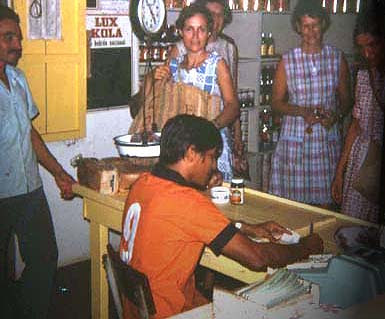
For example, here are two photos of the little commissary at our mission center in South America. That's me in the red shirt. (Oh, my, I was much younger then. And slenderer.  Sigh . . . .)


When I stumbled upon those pictures many years later, I remembered the commissary’s smells: ripe, tropical fruit. Powdered laundry detergent. Broccoli. And rancid bread—if the bread man had come.


And then I remembered the burlap bags. Since we had no paper bags, one of our options was to lug groceries home in colorful locally-made burlap totes. They were coarse and scratchy and had a dried-grass-burlap-ish smell.


And then I remembered the flour I bought at the commissary, hand-scooped (by someone, somewhere—I probably didn’t want to know the specifics) into tiny little plastic bags, usually a bit grimy. 


And then I remembered the weevils that lived in that flour.


And then I remembered that at first, I didn’t know what to do about the weevils. I must have led a very sheltered life because I didn’t even know what weevils were, let alone that they could live in flour.


When I first arrived at the mission center, no one taught me that I could (a) put the flour in the freezer and freeze those little critters to death, or (b) spread the flour on a cookie sheet and bake them to death. Then all I had to do was sift out their lifeless little bodies.


And then I remembered that before I knew how to murder weevils, I fed them to a big crowd. I was asked to bring cinnamon roles to an event and, you guessed it—they were speckled inside with little black, crunchy dots—dead weevils. (You can read more in my memoir, Please, God, Don’t Make Me Go: A Foot-Dragger’s Memoir.)


See what I mean about the value of photos? I knew those stories—but I had forgotten them. I needed to rediscover them. Taking another look at those photos did that for me. And then I could include them and their stories in my memoir.


Sharon Lippincott, too, knows the value and joy of old photos. Reading her "Photographic Memory Jolts" was pure enjoyment for me. From only one photo, she listed dozens of memories.


Take, for example, Sharon’s memories of saddle oxfords. Her post reminded me that every morning before school, I spent a lot of time polishing my own saddle shoes—the white part and the black part.


And I’d forgotten all about my Ivy League saddle shoes with the oh-so-cool little buckle in the back.


And then there was Sharon’s memory of Natalie Wood using Scotch Tape to keep her bangs in place while they dried. Yes, I did that too.


Sharon’s post is a fun read, a treasure trove of history especially if you’re around my age—and all from just one photo!


How about you? Pull out an old photo related to one of the stories in your memoir.


  • What emotions does it stir up?
  • What songs were popular at that time?
  • What styles of clothing, eyeglasses, hairstyles, shoes, furniture, and architecture does the photo capture?
  • Does the photo raise questions?
  • What happened just before the photo was taken? Just afterward?
  • Was something significant brewing at the time, even if you didn’t know it until later?
  • In later years, what happened to the people in the photo?
  • Does it remind you of additional stories?


Go beyond looking at your old photos. What smells come to mind? Textures? Sounds? Tastes? Sights?


Listen. Smell. Feel. Taste. 


Relive. 


Unravel.


I have a hunch you’ll discover details 

that will add gusto to your stories.


Have fun!


Tuesday, November 1, 2022

Back to Basics: Knowing the unique features of memoir will help you tell your story


Since we have new people joining us here at SM 101, we’re reviewing (1) what a memoir is, and (2) how best to write one. (Check out two recent blog posts: Back to Basics: What is a Memoir? and Back to Basics: Why should you write your memoir?)


A memoir is so much more than spinning yarns and telling tales.


That  means you need to understand what a memoir is

in order to

write it in the most effective way.


Below you’ll find some gems—some nitty-gritty basics—to help you get started, to help you keep writing, and to publish your memoir.


“Rather than simply telling a story from her life,

the memoirist both tells the story

and muses upon it,

trying to unravel what it means

in light of her current knowledge. . . .

Memoir includes retrospection as an essential part of the story.

Your reader . . . [is] interested in how you now, 

looking back on it, understand it.”

(Judith Barrington, Writing the Memoir)


“Remember this when you write about your own life.

Your biggest stories will often have less to do with their subject

than with their significance:

not what you did in a certain situation,

but how that situation affected you.”

(William Zinsser, Writing About Your Life)


“Memoir is not about what you did.

Memoir is about what you did with it.”

(Marion Roach Smith)


“Memoir is about something you know

after something you’ve been through.”

(Marion Roach Smith)


Writing a memoir “offers . . . the opportunity to recall, assess,

reflect, and find meaning. . . . Most memoir writing experts agree

that the primary importance of memoir writing

is the resolution, clarity, healing and dignity gained by the author. . . .

Writing memoir is an adventure in attitudes,

with unexpected personal revelations, discoveries and resolution.”

(Sharon Lippincott, author of The Heart and Craft of Lifestory Writing,

and two memoirs)


The main character . . . —in a memoir it’s you!—is changed

significantly by events, actions, decisions, and epiphanies.

The growth and change of the main character

is imperative in any story,

and is the primary reason a memoir is written

to show the arc of character change from beginning to end.”

(Dr. Linda Joy Myers)


Take in these significant quotes about memoirs. Ponder them in relation to the stories you want to include in your memoir.


The better you understand and apply the above, the better your writing experience—and your finished memoir—will be.


Come back next week for more inspiration on writing your memoir!


Tuesday, August 23, 2022

And then I remembered the weevils that lived in that flour


 “I didn’t know you had these pictures, Mom!”


Matt’s face beamed. He grinned his biggest grin, spellbound by photos he held in his hands.


Hushed, he studied one snapshot after another.


“These will be great, Mom, to show my girls the people and places I’ve been telling them about all these years.”


Matt was talking about pictures I took in South America when he was age six through nine and our family lived in a remote mission center at the end of the road in the middle of nowhere.


Those were formative years for my boy. He experienced adventures most kids in North America couldn’t imagine, and they define the man he is today.


Because of Matt’s delight in discovering those old pictures, I scanned old slides by the hundreds, getting prints, scrapbooking them, and then placing them in three-ring binders among written stories from those years. (I told you about that last week and about the memoir I eventually wrote, Please, God, Don’t Make Me Go: A Foot-Dragger’s Memoir. Click on How one old photo led me to write a memoir.)


What are the takeaways for you?


Point #1: Include photos with your memoirs. Your children and grandchildren will be as delighted as my Matt was in seeing our old photos.


Point #2: Photos can help you discover, and then add, detail and richness and depth and breadth to your memoir—and those are important ingredients for (a) capturing readers’ interests and (b) helping them live your stories with you.


Readers can get inside your stories when you recreate them through the five sensessight, sound, taste, touch, and smell. Photos can help you do that. (Remember Peter Jacobi’s words, “No story has a divine right to be read.”)


For example, here are two old, old photos of the little commissary at our mission center in South America. I’m wearing the red shirt. (Oh, my, I was much younger then. And slenderer.  Sigh . . . .)


When I stumbled upon those pictures many years later, I remembered the commissary’s smells: ripe, tropical fruit. Powdered laundry detergent. Broccoli. And rancid bread—if the bread man had come.


And then I remembered the burlap bags. Since we had no paper bags, one of our options was to lug groceries home in colorful locally made burlap totes. They were coarse and scratchy and had a dried-grass-burlap-ish smell.


And then I remembered the flour I bought at the commissary, hand-scooped (by someone, somewhere—I probably didn’t want to know the specifics) into tiny little plastic bags, usually a bit grimy.


And then I remembered the weevils that lived in that flour.


And then I remembered that at first, I didn’t know what to do about the weevils. I must have led a very sheltered life because I didn’t even know what weevils were, let alone that they could live in flour.


When I first arrived at the mission center, no one taught me that I could (a) put the flour in the freezer and freeze those little critters to death, or (b) spread the flour on a cookie sheet and bake them to death. Then all I had to do was sift out their lifeless little bodies.


And then I remembered that before I knew how to murder weevils, I fed them to a big crowd. I was asked to bring cinnamon roles to an event and, you guessed it—they were speckled inside with little black, crunchy dots—dead weevils. (You can read more in my memoir, Please, God, Don’t Make Me Go: A Foot-Dragger’s Memoir.)


See what I mean about the value of photos? I knew those stories—but I had forgotten them. I needed to rediscover them. Taking another look at those photos did that for me. And then I could include them and their stories in my memoir.


Sharon Lippincott, too, knows the value and joy of old photos. Reading her PhotographicMemory Jolts was pure enjoyment for me. From only one photo, she listed dozens of memories.


Take, for example, Sharon’s memories of saddle oxfords. Her post reminded me that every morning before school, I spent a lot of time polishing my own saddle shoes—the white part and the black part.


And I’d forgotten all about my Ivy League saddle shoes with the oh-so-cool little buckle on the back.


And then there was Sharon’s memory of Natalie Wood using Scotch Tape to keep her bangs in place while they dried. Yes, I did that too.


Sharon’s post is a fun read, a treasure trove of history especially if you’re around my age—and all from just one photo!


How about you? Pull out an old photo related to one of the stories in your memoir.


  • What emotions does it stir up?
  • What songs were popular at that time?
  • What styles of clothing, eyeglasses, hairstyles, shoes, furniture, and architecture does the photo capture?
  • Does the photo raise questions?
  • What happened just before the photo was taken? Just afterward?
  • Was something significant brewing at the time, even if you didn’t know it until later?
  • In later years, what happened to the people in the photo?
  • Does it remind you of additional stories?


Go beyond looking at your old photos. What smells come to mind? Textures? Sounds? Tastes? Sights?


Listen. Smell. Feel. Taste.


Relive.


Unravel.


I have a hunch you’ll discover details that will add gusto to your stories.


Have fun!


Tuesday, July 14, 2020

On vulnerability, success, failure, and hope


Let’s read that last part again. “Editors don’t want [and I add: readers don’t want] stories of our great triumphs or successes. Readers identify with failure and find hope in rising above mistakes.”

And then look at this again: “Everything pivots around our vulnerability” (Cecil Murphey and Twila Belk). How do you feel inside when you read those words?

My writer friend, Sharon Lippincott, author of The Heart and Craft of Lifestory Writing, says:

“Easier to say than do, but Amen to this. . . .
Be brave, y’all.
Write the real story.”

Sharon’s right. It’s painful to be vulnerable with our readers. It can be heart-rending to write about our shortcomings and failures.

In fact, it’s often even harder to re-live those experiences in order to write them.

But that’s where the gold is.
That’s where we discover
we’ve grown from the experience, we’ve matured,
we’ve become different, better people.
And that’s what readers want from you.

Memoir is all about transformation.

Write your stories.
You might inspire someone
who has also failed and longs to transform—
to hope that he, like you,
can grow and mature
and live as a different, better person.

What a privilege!


Cecil Murphey and Twila Belk have retired 
but you can still find them on Facebook.


Tuesday, October 22, 2019

Your epilogue tells readers what happened after your memoir’s conclusion


You completed a rough draft of your memoir’s chapters.

Next, you crafted a satisfying, memorable Grand Finale for your readers. (If you missed the last three posts on your memoir’s all-important ending, click on links below.)

Now it’s time to work on your epilogue.

The epilogue plays a different role than your story’s final chapters.  

Your final chapters should be your conclusion. An epilogue is not a conclusion. It serves as a follow-up, telling readers what happened after your memoir’s conclusion.

Readers have come to know you and your story’s main characters. They care about you and your causes and, as a result, they want to know more.

Write your epilogue as a message addressed to those readers.

Your epilogue can answer questions: “Where are they now? What are they doing now?” It can also invite them to get involved in a cause (such as a ministry or blog) by supplying information and links to get them started.

“An epilogue provides comments outside the main action
that give insight into what happened.
The main actions in the book
may take place in one period
and the reader will want to know
what happened afterward.
That kind of follow-up
could appear in an epilogue.”

That’s what my new memoir’s epilogue did. Please, God, Don’t Make Me Go ended when my husband and kids and I left South America and returned to the States, but within the main body of the memoir I had written about what would take place after we left: the kidnapping and murder of our coworker, Chet Bitterman, and the kidnapping of another coworker, Ray Rising. Those were significant events I wanted readers to know about, including long-term ramifications, so I included those specifics in my epilogue.

Epilogues can serve another purpose, too. They can explain to readers what your current view is of what happened in your story.

Since writing memoir requires retrospection, examination, and piecing together past events, writers usually stumble upon key insights they missed earlier in life. Through writing, they gain a perspective that evaded them in the past. They begin to make sense of an experience or relationship.  So, you can use your epilogue to share those insights and current views with your readers.

Sharon Lippincott writes about that function of an epilogue. In her excellent The Heart and Craft of Lifestory Writing, she writes:

“Many stories, especially those about events when you were young, may be more valuable or meaningful to readers if you add a few thoughts at the end about how you see things now. The simplest way to handle this is to add an epilogue explaining the insight you’ve gained that has changed the way you view the situation.”

Sharon gives a couple of examples of wording to use: “I would be middle-aged before I fully comprehended that. . . .” and “Over twenty years later, he was diagnosed . . . and I finally understood . . . .”

Other useful phrases are:

  • Looking back, it now occurs to me that . . . .
  • I had no way to know back then that. . . .
  • The way I see it now, years later. . . .
  • Over the years, I’ve come to accept. . . .
  • Twenty years later, I discovered. . . .
  • It took me a decade to realize. . . .
  • At the time, neither of us knew what was happening or why, but. . . .
Sharon Lippincott also writes about the value of sharing her current-day thoughts from an adult perspective.

She writes this about one of her vignettes, The Rocking Chair: “The main story took place when I was about sixteen. . . . Since the story recounts some typically teenage resentments of my mother, I wanted to temper the harshness of that judgment by pulling the story into the context of adult understanding. I did this in the epilogue rather than spoiling the authenticity of the memory by interjecting current thoughts into the story body.” (from The Heart and Craft of Lifestory Writing)

You can do what Sharon did: share your current-day thoughts in “the context of adult understanding.” Readers will appreciate that.

However you choose to write your epilogue,
create a rich experience for readers,
one that will make them glad they read your memoir.

Perhaps they’ll recommend it to others.

And maybe they’ll even write a review of your book (!!!)
on Amazon, Barnes and Noble, and Goodreads.
(See links below about how to submit book reviews.)


Links for how to submit book reviews:

HOW TO SUBMIT BOOK REVIEWS ON AMAZON. Be sure to check their Community Guidelines. Among other restrictions, if you haven’t spent $50 at Amazon in the past twelve months, you cannot leave a review.

HOW TO SUBMIT BOOK REVIEWS ON BARNES AND NOBLE. Click on links toward the bottom of that page.


Thursday, May 17, 2018

Mother Goes Gaga

You’ll get a kick out of Sharon Lippincott’s essay about her mother. Perhaps it will stir up your own memories of infatuation and heartthrob.

Sharon is a lady you should know. She describes herself as being “hooked on all forms of life writing,” which includes what we’re all about here at SM 101: memoir.

For years Sharon has taught life writing classes and workshops, in person and online, and authored The Heart and Craft of Lifestory Writing, which I highly recommend—it’s one of my go-to books. And you will find oodles of help at her blog, The Heart and Craft of Life Writing.

So, settle in and take a minute or two to enjoy this fun read. Sharon sent it to us after our recent post, Send us your stories about mothers and motherhood. You'll be impressed with her delightful descriptions. We all can learn from her skills.


Mother Goes Gaga

“Let’s go down to Southcenter this morning,” Mother suggests at breakfast. I leap at the idea. I have come over from Richland with two of the kids to pick up our third, who has spent the past week with Mother and Daddy at their new house in Seattle. Trying to keep the kids occupied at her new house is no easy task. They don’t know where things are and don’t have anything to do. They are bored. When they’re bored, they fight. When they fight, Mother gets crazy, and I get a headache from it all. Tomorrow we’ll go home, but today we need to keep busy. A thirty-minute drive down to this major mall should at least kill the morning.

We don’t stay at Southcenter long. The kids each want to run off in a different direction, and shopping for things Mother and I would enjoy is just out of the question.

“Let’s go home,” she announces after about twenty minutes. This isn’t a suggestion or request. It’s an order. We head out to the car and climb in. While the kids squabble over who sits where this time, Mother digs in her purse for her keys. Suddenly she looks up and her head moves forward as she peers intently out the windshield. Her lips are parted. I follow her gaze and notice two men getting in the car parked diagonally in front of us, to the right. The driver is a nicely dressed young man, and an elegantly attractive older man with wavy, snow-white hair opens the door on the passenger side.

Noticing that their headlights are on, I roll my window down and call out to the younger man. “If your car won’t start, it’s because you left the lights on.”

“Oh! Thanks. Could you wait a minute while I check?” he asks, lowering himself into his seat.

I look over at Mother. Her eyes are practically bulging out of their sockets. Her mouth hangs slack, and her knuckles are white from her death grip on the wheel. She gives a weak nod. Sure enough, their car won’t start. The older man lazily unfolds his trim body from the car and saunters in Mother’s direction. She fumbles with the crank in a frenzied attempt to roll the window down. He bends down, leaning his arm casually on the door.

“Do you happen to have any jumper cables we could use?” The words rumble forth, slow sweet, and mellow as well-aged sherry, giving ample exposure to a full set of perfect pearly whites in the process.

“Oh, yes! . . . I’m sure . . . we . . . always carry them!” Mother is stammering. What’s with her? I’ve never seen her in such a state. I get out when she does and walk around to the trunk. She has trouble getting the key in the lock. Again, I’m baffled by her behavior. She’s always had great hand-eye coordination. She finally gets the trunk open and rummages in the contents. She tosses a blanket aside, and moves a couple of small boxes and a mini-cooler. No jumper cables appear. She goes through them all again.

“I . . . I guess I don’t have them today,” she stammers in dismay. “I can’t imagine why they aren’t here. We always carry them.” She’s repeating herself. That’s not like her. Neither is the shrilly quavering voice. She’s acting like a moonstruck teenager, I think. Who is this man, and what has he done to my mother?

“No problem. Thank you so much for checking.” Mystery Man flashes another yard of smile directly at Mother and bows slightly toward her. I half expect him to kiss her hand, but he turns to leave. “Oh! No trouble at all. My pleasure,” she squeaks at his back.

“Try Mall Security. They should be able to help,” I suggest. I don’t want this stranger to think I’m as ditzy as my mother!

“Thank you. Thank you so much. We’ll do that.” He smiles and waves over the top of the door as he slides back into his seat. I watch for a blown kiss, but the moment passes.

Mother sits quietly for a minute, breathing deeply. She’s only a little shaky as she puts the key in the ignition, starts the car and backs out. At this point, I’m relieved that she can manage to drive at all!

“That was Caesar Romero!” she finally gasps as she reaches the end of the lane. “I’ll never wash my car door again!” Her voice has a distinctly misty tone. Now things make sense. I recognize the name of the classic movie star, but wouldn’t have been able to pick him out in a police line-up — unless the others were women. She said she knew he was in town, but of course she never expected to actually meet him.

“Wow, no kidding? He really is a hunk! Good thing I noticed the lights,” I observe with a grin. He hasn’t lost the magic that makes women swoon, I think, especially when they know who he is.

She just nods, lost in a euphoric daze as she heads up the ramp onto I-5. I’m a little awestruck myself. I wonder if I would have been quite so nonchalant if I’d known who he was sooner. I’d like to think so, but in my inner core of truth, I doubt it. I’m glad I didn’t. I decide that only in ignorance could I have given her this gift.

One morning a few months later, Mother is back in Richland for a visit. I’m busy fixing lunches, and she doesn’t say much as she sips coffee, staring out the sliding glass door.

“It really was him!” she announces out of the blue.

“Who? What are you talking about?” I’m lost.

“Him! Caesar Romero!”

“I thought you were sure back then.”

“I was. But he was in Seattle again at the Dinner Theater. We went and sat close to the stage. So now I’m really sure.”

“Wow, that’s great. Maybe someday I’ll run into Robert Redford or Sean Connery in a parking lot somewhere. I wonder if Susan will be with me?”

We both laugh at this happy thought. I turn to unload the dishwasher and she finishes her rice cake.

© 2014, Sharon Lippincott


Sharon has written more than 500 stories and several books including The Heart and Craft of Writing Compelling Description: Selected Blog Posts from The Heart and Craft of Life Writing, and two memoirs, Adventures of a Chilehead, and The Albuquerque Years: My Life as a Preschooler. She serves on the advisory board of National Association of Memoir Writers.


Tuesday, March 20, 2018

Tuesday Tidbit: Beware of using high-resolution photos in your ebook


You’re probably planning to publish your memoir as a book, but Joanna Penn encourages you to also publish an ebook because, she says, “I made 86% of my book sales income from ebook sales. There’s more profit per book because there’s no printing or shipping [charges]. Readers can also buy immediately…. If you don’t have an ebook version, you’re missing out on a chunk of readers and revenue.” Read about more reasons to publish an ebook in Joanna’s post, How to Self-Publish an Ebook.

Beware, however, of using high-resolution photos in your ebook. Joanna advises, “If you have lots of images in your book,… you will have … a bigger file size, and although ebooks are typically free in terms of delivery, Amazon does include a delivery cost in their pricing setup. That will be higher if you have a bigger file, and images can really expand the file size. If your delivery cost goes too high, you’re not going to make much royalty.”

Darcy Pattison says it this way: “…My profit is being eaten up with Amazon’s delivery fees. In a recent month, I calculated about 20-25% of the gross receipts for my ebooks went directly to delivery fees.... 20-25% in delivery fees! That’s outrageous! The culprit is the file size of a . . . full color illustrated picture book.”

But you want high-quality photos and illustrations, right?

My grandson on the pitcher's mound
So what should you do?

Joanna suggests using a small number of photos in ebooks but posting lots of others on your website/blog and Pinterest. Other pros also encourage using Instagram. And then there’s your Facebook Author Page as well.

But you have other ways to work around the problem. Darcy Pattison offers a very detailed how-to in her post, How to Format Pictures Books for Kindle and ePub3.

It’s a long post and I confess I haven’t read it in its entirety, but believe me, when I’m ready to publish my new memoir as an ebook, I will pore over Darcy’s post. It appears to be a valuable help for all of us.

For now, look over Darcy’s post, How to Format Pictures Books for Kindle and ePub3. She offers you a rich resource!

And do not miss Sharon Lippincott’s post, Photo Scanning Tips for CreateSpace. It’s packed with information you need to know!


So there you have it, your Tuesday Tidbit.

Tuesday, November 1, 2016

Tuesday Tidbit: More info about CreateSpace


Sharon Lippincott left this helpful comment
after Thursday’s guest post by Dwight Clough.
(If you missed his post, click on Two self publishing options for memoir authors.)


…CreateSpace is a good option for those who want nothing more than copies for friends and family. You can order ‘real books’ from CreateSpace for less than the cost of printing at home and about the same as a copy shop.

You do not have to list your project on Amazon. Order as many copies as you wish from CreateSpace, then either unlist it or remove it.

Leaving it listed on CreateSpace is a good option though so you can let people who want to read it order their own copies. (You do not have to add a royalty for CreateSpace, leaving the public price the same as wholesale.) If you leave it there and don’t promote it, few will ever order.

You will need to provide tax ID information to set up an account. This is required by their accounting system, but if you receive no royalties, none will be reported to the IRS and you’ll have no extra lines to fill out on your tax return.


Many thanks, Sharon, for that good info.

Sharon Lippincott authored The Heart and Craft of Lifestory Writing: How to Transform Memories into Meaningful Stories and several memoirs and books. She teaches classes and workshops on Lifestory and Memoir Writing, and Writing with All Your Senses. Click here to check out her blog, The Heart and Craft of Life Writing.


Thursday, February 5, 2015

They can sneak up on you: Benefits of writing your memoir


We write our stories because we believe others—our readers—will benefit from them. And they do.

But many of us are surprised at how beneficial writing our stories can be for usthe writers.

The insights, the healing, the clarity, the hope, the joy—marvels that have been there all along, hidden to us—well, they can all kind of sneak up on us writers. They can delight us. They can change our lives for good.

"Writing is a process in which we discover what lives in us," writes Henri Nouwen. "The writing itself reveals what is alive. The deepest satisfaction of writing is precisely that it opens up new spaces within us of which we were not aware before we started to write." 

"There are many good reasons for writing that have nothing to do with being published," says William Zinsser. "Writing is a powerful search mechanism, and one of its satisfactions is that it allows you to come to terms with your life narrative. It also allows you to work through some of life's hardest knocksloss, grief, illness, addiction, disappointment, failureand to find understanding and solace."

Elizabeth Andrews writes, "The writing itself becomes a means for spiritual growth. Often the writer stumbles on this strange occurrence mid-draft, suddenly discovering that writing can be an avenue for prayers, or a means of wrestling with angels, or a form of contemplation."  

"We find the effort of organizing our thoughts and memories in story form deepens their meaning, and we often mine gems of insight and joy from the dirt of the past," writes Sharon Lippincott. "Life takes on richer meaning and becomes more satisfying."  

Sharon also writes, "All of the dozens of memoir authors I've asked have confirmed that writing has changed their view of life, leaving them happier, healthier, and more serene."  

"In thinking back, we see [God's] hand and see how far we have come. There's no way to predict specifics in the future, but if we see God's hand and how he has blessed us, it totally prepares us to live in joyful and blessed ways." (Pastor Sid Tiller's sermon, A Thousand Generations, based on Psalm 100:5; August 21, 2011)


We receive so many blessings
by taking the time and
making the effort to write our stories.
What are some of the blessings and benefits
you've discovered?
Be sure to leave a comment below or on Facebook.