Showing posts with label Cecil Murphey. Show all posts

Tuesday, June 13, 2023

Back to Basics: Dialogue enriches your memoir—but how can you reconstruct old conversations accurately?


Dialogue, well written, can accomplish important goals for your memoir. It can:

  • acquaint readers with key characters’ personalities, values, perspectives, emotions, and attitudes
  • add pizzazz—or grief or terror
  • present information readers need to know including backstory (significant events from the past)
  • let readers feel they’re experiencing your story (important)
  • keep up your story’s momentum
  • entice people to keep reading.


But crafting dialogue can be problematic.

How can you accurately reconstruct conversations

from years ago

if you don’t have them on tape or videotape?


If you call your story a memoir, you claim to have written a factual story (not fiction), and you’re promising readers you’re telling them the truth. Readers want to trust you. They need to trust you. If they can’t rely on your dialogue, how can they believe the rest of your story?


Here’s good news: You can’t always succeed in penning decades-old conversations with complete accuracy.


And that’s okay. Take comfort from Cecil Murphey’s words:


“Most readers are smart enough to figure out

that dialogue isn’t word-for-word accuracy;

however, they assume the author strives

to be as close to truth as possible.”


So, reconstruct past conversations with integrity. Avoid distortions. Create dialogue that represents your characters, situations, and events truthfully.


In writing rough drafts of my two memoirs, I contacted people involved so I could correctly write dialogue. I suggest you do the same.


And when I published my second memoir, Please, God, Don’t Make Me Go: A Foot-Dragger’s Memoir, I included this disclaimer:


This is a work of creative nonfiction. Because these events happened nearly half a century ago, some people’s memories might not match mine, but memory is a wobbly thing—for both writer and readers. Based on journal entries, letters I wrote . . . , verifiable historical incidents, and accounts supplied by many people, I believe I’ve written accurately about places, dates, events, individuals, and situations. I recreated dialogue to portray the original conversation in tone and content. For security reasons, I changed some names, as noted.


Now let’s take a look at well-written, effective dialogue. In the following excerpt, Pick and his wife Cameron are attending a fancy dinner party in New York. Pick, the narrator, writes about one guest, Felicity, who glared at him as he visited with the hostess, Rita:


My southern drawl seemed to unnerve her. . . . Finally, in a vaguely British accent she asked, “I gather you’re not from around here?”


“No, ma’am,” I said. “How could you tell?”


. . . . “Then where are you from exactly?”


“Charlotte, most recently,” I said.


“Charlotte?” Her nose squinched, as if I had answered Kazakhstan. . . .


“I don’t see how anyone could possibly stand living down there with those people.”


“Those people? You mean my kinfolks?”


“Surely your relatives are not . . .” She smirked at Rita. “Oh, you know . . . .”


I felt my pulse quicken. “Actually, I don’t.”


“Well”—she quaffed her wine— “I’m certainly not going to explain.”


“Have you ever been down South?” I asked.


“Once. I did a commercial shot down there somewhere—” . . . “Raleigh. That was it. Dreadful place . . . I would never live down there.”


Our hostess [Rita] smiled diplomatically and asked, “Why not? I hear it’s lovely.”


Felicity looked at me. “I couldn’t take all the racists down there.”


. . . “How about some duck roast?” Rita chirped, trying to pull the conversation out of the nosedive it had taken. . . .


. . . “Besides,” [Felicity] continued, “southerners sound so . . . ignorant. . . .  I could barely bring myself to vote for Jimmy Carter because of that accent of his.”


“Well, ma’am”—the chill in my voice could have frozen hummingbirds in mid-flight— “where I come from we call that bigotry.”


Suddenly, all conversation ceased at the table. All eyes . . . focused on me. . . .


“Please pass the bread, Pick” said Cameron, her face flushing.


“Hold on, Cam,” I said.


“Pass the bread, Pick!”


Rita scrambled for the bread basket, desperate to do something, anything. . . . (from The Bridge by Doug Marlette)


Through that dialogue, you witnessed the dynamics between these four people. You sensed the tension. You discerned Felicity’s personality. What did you learn about Pick? About his wife, Cameron? About the hostess, Rita? Just think—Marlette accomplished all of that through a few lines of dialogue!


Next week we will continue with dialogue, but for now, study the above conversation and experiment with similar techniques to develop your main characters, their settings, and interpersonal dynamics.


Good dialogue is essential to your memoir.


If you doubt that, ponder Joan Didion’s words:


“I don’t have a very clear idea of who the characters are

until they start talking.”


Have fun writing your memoir!


Tuesday, May 9, 2023

Back to Basics: “Make ‘em wait”


Continuing with

“Make ‘em cry, make ‘em laugh, make ‘em wait.”

Wilkie Collins (1824-1889)


Why should you avoid opening a story in the following way? 


“We eventually found Old John, alive, buried under four feet of tree limbs—the elephant had buried him the way elephants bury their own—but for six hours we didn’t know if we’d ever find him, dead or alive.”


If you begin your story this way, you have given away your ending. That weakens the power of your story. It diminishes readers’ involvement.


Giving away the ending spoils 

an essential element of a good story: 

suspense.


Remember this definition:


A quality story “will consist of a real person who is confronted with a significant problem, who struggles diligently to solve that problem, and who ultimately succeeds—and in doing so becomes a different character” (Jon Franklin, Writing for Story). Note the tension and suspense: (1) a significant problem which (2) the character struggles diligently to solve.


In other words, “A story consists of a sequence of actions that occur when a sympathetic character encounters a complicating situation that he confronts and solves” (Jon Franklin, Writing for Story). Note the tension and suspense: (1) a complicating situation which (2) the character confronts. (Jon Franklin is a two-time Pulitzer Prize winner and a well-known pioneer in creative nonfiction.)


Writers develop what Franklin calls “a sympathetic character” and “a real person” when they make readers cry and laugh, which we covered in previous blog posts, based on Wilkie Collins’ quote, “Make ‘em cry, make ‘em laugh, make ‘em wait. (See recent posts if you missed them.)


Today let’s take a closer look at Collins’ advice to “make ‘em wait” for resolution.


After all, as you lived the stories in your memoir, you endured a time lag—maybe months, maybe years—before you found resolution.


You didn’t know how the incident would end.

You had to wait. Make your readers wait, too.


Here’s why: Readers open the pages of your book because they want to learn from you. They know you weren’t handed an easy fix—that’s not the way life or God work—so they don’t want you to offer them a trite, instant, easy fix.


“We desperately want our situation solved. We want resolution. But God unfolds the plot in his own time. It is in our months or years of waiting that our story comes to maturity” (Dan Allender, To Be Told).


James wrote about coming to maturity when he penned, “the testing of your faith develops perseverance. Perseverance must finish its good work so that you may be mature and complete, not lacking anything” (James 1:3-4).


Readers know you came to the maturity

that James and Allender highlight

—they just don’t know how—

and they want to discover it.

They want to mine the gems that formed

during your coming to maturity.


Pat answers or platitudes won’t do.

They want the real thing:


They want to tag along with you

to see how, step by step, you dealt with your problem

so they can deal with theirs.


Step by step means you let readers experience the suspense you experienced. “Make ‘em wait.”


Perhaps your calamity, your unwelcome surprise, your tragedy arose from cancer, or an addiction—yours or someone else’s.


Maybe, like friends of mine, you were kidnapped by Marxist guerrillas.


Perhaps you were a victim of road rage or of a mass shooting.


Or maybe you said, “As for me and my household, we will serve the Lord” (Joshua 24:15), and that led to being misunderstood and scorned, and it required sacrifice and courage beyond your expectation.


Perhaps your child got into trouble with the law, or your spouse betrayed you. Or you lost your job and health insurance, and then you lost your house.


Whatever your incident, spell it out for readers.


Keep in mind that making ‘em cry

will be a companion to making ‘em wait;

they will be intertwined.

Specify, in sufficient depth,

why your crisis made you “cry”

and invite readers to “cry” with you.


Just be sure to hold readers captive.


Explain what was at stake. What were the possible outcomes? Which did you hope for? Why? Which outcome did you fear most? Why?


Detail the complications and disappointments and setbacks.


Share your doubts.


Unravel the story as you lived it—unable to see into the future—and let readers unravel it with you.


Pull readers in. If you gave in to despair, write in such a way that readers experience your despair with you.


Admit to weeks or years of faltering faith.


Tell about your tears, sleepless nights, and prayers.


Describe the times God seemed silent.


Keep your frustrated goals before your readers. Leave them hanging.


Make them curious: Leave readers wondering about the outcome.


When they finish a chapter of your memoir, make ‘em worry for you. Make ‘em wonder what will happen in the next chapter.


Save the resolution for the conclusion. When that time comes, tie everything together. Make sense of your crisis.


In good memoir form, tell how you changed and matured, how you knew God better than before, how you came to understand His ways and His love. How did the experience strengthen your faith for future situations? What new person did you become as a result of the experience?


Keep up the suspense.


Don’t tell readers the end until the end!


Tuesday, February 21, 2023

Back to Basics: Refuse to let cardboard characters lurk in your memoir!


“No one wants to be known for writing flat, boring, cardboard characters,” says Carly Sandifer.


“. . . Pick the particularly telling details that can make the difference between a cardboard character and a real, live person,” Judith Barrington says. It’s a matter “of selecting those few [details] that capture the essence of the person . . . .” (Writing the Memoir)


That’s your goal as a memoirist: “Capture the essence of the person.”


How, specifically, can you do that?


By employing the good old tried-and-true principle:

SHOW, DON’T TELL.

SHOW your main characters to your readers

rather than TELL readers about them.


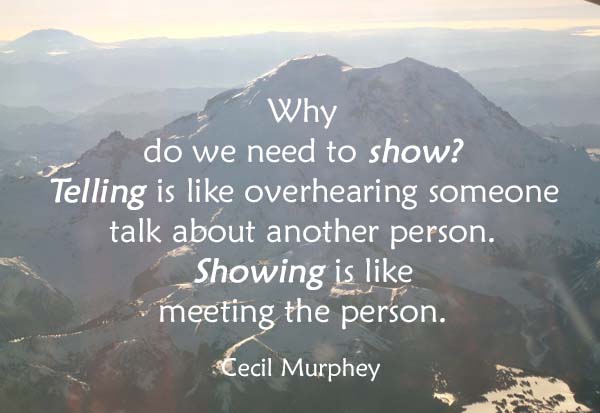
“Why do we need to show?” asks author Cecil Murphey. “Telling is like overhearing someone talk about another person. Showing is like meeting the person.”


For example, instead of telling readers that a lady was “beautiful,”

show readers—describe her in such a way

that your reader will conclude for himself, “She was beautiful.”


Mark and Delia Owens could have told readers that Lionel was a problem drinker and a partier, but instead, they showed readers. They wrote:


“Lionel Palmer, deeply tanned, his dark hair brushed with grey, was dressed in baggy jeans, a cowboy shirt, and a bandana. He sauntered out to greet us, holding a glass of whisky in his hand. The oldest and most experienced professional hunter in the area, Lionel held considerable social position in Maun. He was famous for his parties, where bedroom furniture sometimes ended up on the roof, and once a Land Rover had been hung in a fig tree—and for his capacity for Scotch. Once, after several days of intoxication, he woke up with a stabbing earache. The doctor at the clinic removed a two-inch-long sausage fly—a reddish-brown tubelike, winged insect—which had taken up residence in Lionel’s numbed ear while he slept off his drunkenness in a flowerbed. For a week Lionel carried the fly’s carcass bedded down in a cotton-lined matchbox, proudly showing it to everyone he met, whether or not he knew them.” (Cry of the Kalahari)


Notice the way author Kristin Hanna showed Anouk to readers:


"Isabelle looked up, expecting to see German soldiers, but it was Anouk. She was dressed, as usual, more for her temperament than the season, in all black. A fitted V-neck black sweater and straight skirt with a black beret and gloves. A Gauloises cigarette hung from her bright red lips.


"She paused at the open doorway. . . . The Germans turned. Anouk let the door shut behind her. She casually lit her cigarette and inhaled deeply. . . .


"Anouk walked forward with a regal, disdainful air. . . . The Germans fell silent, watching her, moving sideways to let her pass. Isabelle heard one of them say ‘mannish’ and another ‘widow.’


"Anouk seemed not to notice them at all. At the counter she stopped and took a drag on her cigarette. The smoke blurred her face, and for a moment, only her cherry-red lips were noticeable. . . .


"Anouk turned and left the bookshop. It wasn’t until the bell tinkled that the spell broke and the [German] soldiers began speaking again.” (Nightingale)


Here’s another example, this one from Fred Craddock’s “Preaching as Storytelling”:


“‘There was this beggar sitting at the gate.’ Wait a minute. Give me a chance to experience the beggar at the gate. See the rags, smell the odor, hear the coins in the tin cup, see the hollow eyes.” (from The Art and Craft of Biblical Preaching)


Think about your memoir’s main characters.


If one of them was smarmy, find words to craft a scene showing readers he was creepy.


If she was weird, create a scene to show she was strange. Bizarre. Eccentric.


If he was intellectual, use words to show he was cerebral. Scholarly.


Let readers in on a person’s idiosyncrasies and gestures. Did she live life at a half-run, or did she plod through life?


Did he make people uncomfortable by standing too close when he talked with them?


Did he make a funny little noise in his throat when he was nervous?


Instead of telling readers “He was angry,” show them his clenched jaw, flared nostrils, red face, or cold flashing eyes. Let readers hear the yelling and the slammed door.


Capture sweet moments, hilarious times, personality quirks, demonstrations of courage, integrity, tenacity in the face of obstacles, or high adventure—all make for great reading.


Consider the following when developing your main characters. Was he/she:


Generous or selfish

Dull or quick-witted

Charming or dreary

Stand-offish or welcoming

Gentle or gruff

Thoughtful or insensitive

Tall or short

Plump or skinny

Young or old

Agile or awkward

Generous or stingy

Composed or nervous

Gloomy or merry

Foolish or wise

Erratic or steady

Polished or frumpy

Uncouth or refined

Hilarious or humorless


“This is the recording of everyday gestures, habits, manners, customs, . . . clothing, decoration, styles of traveling, eating, keeping house, modes of behaving toward children, servants, superiors, inferiors, peers, plus the various looks, glances, poses, styles of walking and other symbolic details that might exist. . . .” (Roy Peter Clark quoting Tom Wolfe)


Your job is to develop multi-dimensional,

memorable, compelling, well-rounded personalities.


Capture unique details about your main characters—

physical, emotional, psychological, spiritual.

Reveal personality, beliefs, idiosyncrasies, and heart.


Develop characters your readers can experience

in the ways you experienced them.


 Take a minute to read Cecil Murphey’s post, “Show me! Show me!”


You’ll also enjoy Carly Sandifer’s post, “What I learned from Truman Capote about character description.” In it, Carly wrote, “Capote didn’t have to write about [tell readers about] his character, ‘She was a moral person,’ because he shows it.”


Tuesday, January 31, 2023

Back to Basics: How’s your progress in describing your memoir’s key places?


Are you making progress in describing the key places—the key settings—in your memoir? I hope our recent blog posts have inspired you. (Click on Details, a must for your memoir;  It’s super fun to gather “crackly” words. . . . ; and The importance of “place”. . . . )


Today I offer you more inspiration:

Write your memoir so that 

your “reader gets zipped into your skin,” 

in the words of memoir guru Mary Karr. 

When you include sensory details 

(smell, taste, sight, sound, and touch), 

readers will feel drawn into your story with you—

and when they’re “zipped into your skin,” 

your message will make its way into their hearts and minds.


Think back: Think of a book that made you feel you were in the story, smelling scents she smelled, tasting flavors he tasted, seeing sights he saw, hearing sounds she heard, feeling textures he felt. 


Often the best way to learn how to describe a place 

is to study how others have done that.


With that in mind, notice sensory details of sight and sound that Naomi Benaron used in her novel set in Rwanda, Running the Rift:


“He stood until the truck became a speck in the red swirl of dust. When even the speck had disappeared, he broke into a run down the road, where life paraded on as if nothing had changed. He strained up the hill, sacks of sorghum and potatoes draped over bicycle handlebars or stacked in rickety wooden carts. Children herded goats fastened with bits of string, lugged jerricans filled with water, trotted with rafts of freshly gathered firewood on their heads. Women chatted on the way to and from the market, basins filled with fruits and vegetables balanced like fancy hats.”  


Because I lived in East Africa for several years, Benaron’s details transported me back. For those not acquainted with that culture, her details offer an authentic view of life there. Her words make the reader feel he’s in the scene.


Notice details of sight, sound, and smell in another excerpt from Running the Rift:


“Market goers created a congestion through which the truck barely moved. In the dying afternoon, hawkers called out bargains, packed up unsold tools and clothing, used appliances held together with hope and string. Flies swarmed around carcasses of meat. The aromas of over-ripe fruit and gamy animal flesh made Jean Patrick queasy. A bicycle taxi swerved into their path. . . . The woman on the back loosed a stream of insults in their direction. The radio droned; the truck engine whined and coughed. Their bodies jostled together from the potholed road. . . .”


Butch Ward offers advice inspired by Jacqui Banaszynski: 


“Write cinematically. 

Movies pull us through stories with strong themes, 

compelling characters and revelatory details. 

Written stories can do the same thing. . . . 

Zoom in tight on details or images 

that have the most meaning; 

be descriptive and specific.”


Caution: Avoid subjecting readers to irrelevant details—details that don’t enhance your main settings, details that don’t pertain to the point of your story/vignette.  Extraneous details slow down your story.


Revisit key places and scenes in your rough draft and ask yourself, “What did the place smell like?” Were you in a stable, or at the perfume counter in Macy’s?


Ask yourself “What noises were in the background?” The rumble of trains? The hush of snowfall?


What did you see in the distance? Mountains? Unending desert? Jungle? What did you see within your immediate surroundings?


If you were with a group of individuals eating tadpoles in okra sauce, how did that feel on your tongue? What was the texture? Find words to describe the taste and smell.


Include details that invite readers 

to encounter the same experiences you did. 

“Zip them into your skin.”


Tuesday, May 10, 2022

Does your opening make your memoir a must-read?


In writing your memoir, you must craft every aspect well, but your beginning could make or break your entire book.


Because of that, you’ll need to create curiosity, draw readers in, and keep them reading.


An opening is probably the hardest for all of us to create, whether we’re composing a book, vignette, newspaper or magazine article, blog post, inspirational talk, or sermon.


Brian Clark drives home that point:


“Master copywriter Gene Schwartz

often spent an entire week on the first 50 words. . . .

Those 50 words are the most important part

of any persuasive writing,

and writing them takes time.

Even for the masters.”


Read that again: “ . . . writing them takes time. Even for the masters.”


How are you doing on crafting your memoir’s beginning?


Here are a few tips:


Remove your scaffolding. (Don’t miss that link!) Your first few paragraphs must be the correct ones.


Be sure your beginning doesn’t give away the ending. This might seem like a no-brainer, but too many people goof on that.


Prolific author and New York Times bestselling author Cecil Murphey says, “I once read more than one hundred of the entries for Christmas Miracles, a compilation book. The major flaw in at least a third of them was that they told us the ending before they told us the story.” Cecil gave this example: “The worst Christmas of my life became the best Christmas ever.”


Instead of giving away the ending, intrigue your readers: Entice them to keep reading so they’ll discover how your memoir ends.


When I teach memoir classes, I encourage people to do what I did when I was a journalism student (and still do today): Study openings written by pros.


Be an eager student: Go to the library, or browse around a book store, or look through your own stack of books, or look inside memoirs on Amazon—but only those written by pros. Study how they do it.


Scrutinize the start of everything you come across—newspaper articles, magazine articles, literary journals, fiction—anything written by pros, and study how they do it.


Once you’ve acquainted yourself with professionally composed openings, look at how non-pros write them. 


By studying beginnings penned by 

both pros and beginners, 

you’ll recognize what works 

and what doesn’t. 

And you’ll become more skilled 

at creating your own memoir’s opening.


Remember: Plan to take plenty of time to create just the right beginning.


The first part of your memoir can make or break the whole book.


An effective start can motivate a person 

to keep reading,

but a weak one could persuade him 

to close your memoir and walk away.


Put in the hard work needed to make your opening zing.


Tuesday, May 3, 2022

Does your memoir’s beginning pass the test?


After you’ve worked a while on your memoir, take another look at its opening. Because you’ve focused on other parts of your story for a while, you can now take a fresh look at its beginning.


Ask yourself:


  • Will it grab my readers?
  • Will it surprise them?
  • Stir up curiosity?
  • Make them laugh? Or make them cry?
  • Will it intrigue them? Charm them?
  • Will it motivate them to keep reading?


If not, rewrite your beginning.


And please don’t feel bad about that.

Everyone reworks their stories’ beginnings.

Everyone!


Stay tuned.

 Next week, we’ll take an in-depth look

at how to craft a good beginning.


Tuesday, February 16, 2021

“Make ‘em wait”


Continuing with

“Make ‘em cry, make ‘em laugh, make ‘em wait.”

Wilkie Collins (1824-1889)


Why should you avoid opening a story in the following way?  


“We eventually found Old John, alive, buried under four feet of tree limbs—the elephant had buried him the way elephants bury their own—but for six hours we didn’t know if we’d ever find him, dead or alive.”


If you begin your story this way, you have given away your ending. That weakens the power of your story. It diminishes readers’ involvement.


Giving away the ending spoils essential elements in good stories: tension and suspense.


A quality story “will consist of a real person who is confronted with a significant problem, who struggles diligently to solve that problem, and who ultimately succeeds—and in doing so becomes a different character” (Jon Franklin, Writing for Story). Note the tension: (1) a significant problem which (2) the character struggles diligently to solve.


In other words, “A story consists of a sequence of actions that occur when a sympathetic character encounters a complicating situation that he confronts and solves” (Jon Franklin, Writing for Story). Note the tension: (1) a complicating situation (2) the character confronts. (Jon Franklin is a two-time Pulitzer Prize winner and a well-known pioneer in creative nonfiction.)


Writers develop what Franklin calls “a sympathetic character” and “a real person” when they make readers laugh and “make ‘em cry,” which we covered in previous blog posts, based on Wilkie Collins’ quote, “Make ‘em cry, make ‘em laugh, make ‘em wait. Click on those links if you missed them.


Today we’ll look at tension and suspense, and Collins’ advice to “make ‘em wait” for resolution.


After all, as you lived the stories in your memoir, you endured a time lag—maybe months, maybe years—before you found resolution. You didn’t know how the incident would end.


You had to wait. Make your readers wait, too.


Here’s why: Readers open the pages of your book because they want to learn from you. They know you weren’t handed an easy fix—that’s not the way life, or God, works—so they don’t want you to offer them a trite, instant, easy fix.


“We desperately want our situation solved. We want resolution. But God unfolds the plot in his own time. It is in our months or years of waiting that our story comes to maturity” (Dan Allender, To Be Told).


James wrote about coming to maturity when he wrote, “the testing of your faith develops perseverance. Perseverance must finish its good work so that you may be mature and complete, not lacking anything” (James 1:3-4).


Readers know you came to the maturity that James and Allender highlight—they just don’t know how—and they want to discover it. They want to mine the gems that formed during your coming to maturity. Pat answers or platitudes won’t do.


They want the real thing: They want to tag along with you to see how, step by step, you dealt with your problem so they can deal with theirs. 


Step by step means you let readers experience the suspense you experienced. “Make ‘em wait.”


Perhaps your calamity, your unwelcome surprise, your tragedy arose from cancer, or an addiction—yours or someone else’s.


Or maybe you said, “As for me and my household, we will serve the Lord” (Joshua 24:15), and that led to being misunderstood and scorned, and it required sacrifice and courage beyond your expectation.


Perhaps your child got into trouble with the law or your spouse betrayed you. Or you lost your job and health insurance, and then you lost your house.


Whatever your tension-inducing incident, spell it out for your readers.


Keep in mind that making ‘em cry

will be a companion in making ‘em wait;

they will be intertwined.

Specify, in sufficient depth,

why your crisis made you “cry”

and invite readers to “cry” with you.


Hold readers captive.


Explain what was at stake. What were the possible outcomes? Which did you hope for? Why? Which outcome did you fear most? Why?


Spell out complications and disappointments and setbacks.


Share your doubts.


Unravel the story as you lived it—unable to see into the future—and let readers unravel it with you.


Pull readers in. If you gave in to despair, write in such a way that readers experience your despair with you.


Admit to weeks or years of faltering faith.


Tell about your tears, sleepless nights, and prayers.


Describe the times God seemed silent.


Keep your frustrated goals before your readers. Leave them hanging.


Make them curious: Leave readers wondering about the outcome.


When they finish a chapter of your memoir, make ‘em worry for you. Make ‘em wonder what will happen in the next chapter.


Keep up the suspense.


Just don’t tell them the end until the end!


Save the resolution for the conclusion. When that time comes, tie everything together. Make sense of your crisis. Tell, specifically, how you and God succeeded in reaching a good conclusion.


In good memoir form, tell how you changed and matured, how you knew God better than before, how you came to understand His ways and His love. What did you learn from the times God was silent? How did the experience strengthen your faith for future situations?


What new person did you become as a result of the experience?


Let readers feel the same surprise and joy and hope you did.


Tuesday, July 14, 2020

On vulnerability, success, failure, and hope


Let’s read that last part again. “Editors don’t want [and I add: readers don’t want] stories of our great triumphs or successes. Readers identify with failure and find hope in rising above mistakes.”

And then look at this again: “Everything pivots around our vulnerability” (Cecil Murphey and Twila Belk). How do you feel inside when you read those words?

My writer friend, Sharon Lippincott, author of The Heart and Craft of Lifestory Writing, says:

“Easier to say than do, but Amen to this. . . .
Be brave, y’all.
Write the real story.”

Sharon’s right. It’s painful to be vulnerable with our readers. It can be heart-rending to write about our shortcomings and failures.

In fact, it’s often even harder to re-live those experiences in order to write them.

But that’s where the gold is.
That’s where we discover
we’ve grown from the experience, we’ve matured,
we’ve become different, better people.
And that’s what readers want from you.

Memoir is all about transformation.

Write your stories.
You might inspire someone
who has also failed and longs to transform—
to hope that he, like you,
can grow and mature
and live as a different, better person.

What a privilege!


Cecil Murphey and Twila Belk have retired 
but you can still find them on Facebook.