Showing posts with label Kathy Pooler. Show all posts

Tuesday, April 2, 2019

Tuesday Tidbit: Whoa—I think this has to be a God-thing!


Reading time: 1 minute, 20 seconds

If all goes well, in a matter of hours I should hit the “send” button and propel my memoir closer to publication: Please, God, Don’t Make Me Go! A Foot-Dragger’s Memoir.

And less than 24 hours ago, something astonishing happened. It has to be a God-thing. I’m still rather stunned, but so excited about it.

Let me tell you what happened.

Yesterday afternoon, I was taking a snapshot of my granddaughter after she competed in a track meet. She’s the one in red with her back to the camera.


But then, a man on the right, wearing black, caught my attention. I looked again and . . . Yes! It was Glenny Gardner! (Actually “Glenn” now—he’s all grown up.)

Glenny was about six years old, maybe seven, when he popped into our lives. That was in 1976 on my family’s first day at a remote mission station named Lomalinda (pretty hill) in rural South America.

You’ll have to read the memoir to get the whole impact of the welcome Glenny gave me that day. For now, let’s just say it involved a boa constrictor a few inches from my face, cradled in Glenn’s hands, and, on my part, a lot of hollering. And a hurried snapshot in an attempt to apologize to Glenny for screaming at him.

Glenny and his boa constrictor

Many years later that photo, and the lesson I learned from Glenn, hit me so hard that I had to write a memoir about the three years my husband and kids and I lived in Lomalinda. And by the way, the photo I took that day is on the cover of my memoir.

And somehow, yesterday God blessed my socks off by bringing Glenn and me to the same middle school track meet. I hadn’t seen him in 40 years. What a great gift it was to see him again and swap stories and meet his wife and daughters.

Running into Glenn just hours before sending off my memoir to the publisher—it just had to be a God-thing, don’t you agree? I can see His fingerprints all over it!


Glenn and me yesterday at the track meet

Tuesday, September 25, 2018

Tuesday Tidbit: “Unveiling all the painful truths”


“Unveiling all the painful truths would expose my children,” writes memoirist Kathleen Pooler, “and I constantly asked myself:

“Do I have the right to do that? Will it be worth it? Will it affect our relationship as adults?

“I knew I could not publish this story without the full cooperation of both my children.”

And Kathy’s children, bless their hearts, did give their mother their full cooperation.

“The answers to those questions,” continues Kathy, “all came in due time as the years passed and distance helped us all sort through the many layers of feelings. . . .

“This may be my story but it is also their story. . . . I think of my memoir as a love letter to them.”

Wow. Read that again: “I think of my memoir as a love letter to them.”

Soon you can read Kathy’s second memoir, Just the Way He Walked: A Mother’s Story of Hope and Healing. Watch for it!

Read her entire blog post, The Dedication of My Second Memoir: A Mother’s Story, and be sure to follow her at Kathleen Pooler Author on Facebook.

We all have a lot to learn from Kathy.


Kathy reminds me of this Elisabeth Elliot quote. Kathy’s blooming! 
And her memoir will inspire you to bloom, too.

There you have it, your Tuesday Tidbit.


Thursday, April 19, 2018

The Agony and Ecstasy of Memoir Writing: Digging Deep


If you’re writing about—or trying to write about—an excruciating experience, you’ll identify with Kathy Pooler.  

She’s a dear lady and fellow memoirist who today shares with us—in a transparent, sometimes painful way—the agony as well as the ecstasy she’s faced while writing her second memoir.

So, we welcome you, Kathy, and look forward to the insights, advice, and encouragement you have for us, your fellow memoirists.


As I work on my second memoir, Daring to Hope: A Mother’s Story of Healing from Cancer and Her Son’s Alcohol Addiction, I find myself knee-deep in the swamp of memories that pop up at the strangest times—when I’m standing in line at the grocery store or trying to fall asleep at night.

I call them “scene pops” and have learned that anything that keeps me up at night is worth writing down.

When you write a memoir, the story is always with you. The challenge is to capture the moments that will invite and keep your reader in the story. The moments that matter.

But just when I think the manuscript is finished enough for a professional editor, I think of another scene or detail that I need to include. It feels like a faucet has been turned on and keeps flowing. The story is not quite ready, much like baking a cake requires all the right ingredients before you put it in the oven. My story needs a few more ingredients before I ship it.

Like most things in life, timing is everything.

How much deeper do I need to go?

My writing group tells me that I need to show more about why seeing my fourteen-year-old son drunk for the first time was so horrifying to me. They have challenged me to keep digging deeper so that the reader will feel and understand my responses.

This is the agony part . . . the part where revisiting painful memories stirs up deep-seated emotions.

A litany of questions bombard me:

Why didn’t this young mother take action sooner?

What could she have done that would have made a difference?

How could she stand to look into her son’s hollow eyes and not want to rescue him from his self-destructive tendencies?

How can she not blame herself for her son’s addiction?

How does a mother handle an addicted child while fighting her own cancer?

In Writing Down the Bones, Natalie Goldberg notes:

“Caress the divine details, touch them tenderly. Let your whole body touch the river you are writing about, so if you call it yellow or stupid or slow, all of you is feeling it” (page 50).

I’m listening and caressing those divine details in what I call “manageable doses,” meaning I work on it for brief periods of time, then put it aside. Sometimes I need a few days before I revisit it. As time goes by, the amount of time I need to stay away has decreased. There were times when I shelved this project for months as I worked through the sensitivities of writing about my children.

Too. Darn. Painful.

I want to honor the story and do it justice. Giving myself time to process it is part of taking care of myself so the story can take care of itself.

The only way to the other side of the swamp is through and, as long as I keep writing, I can begin to see the shoreline in sight.

Memoir writing is a journey of self-discovery that slowly reveals itself layer by layer.

There are surprises, detours, and potholes along the way. But if I keep persisting on the path, I trust it will make sense.

Here’s the ecstasy part . . . treasures that are unearthed as I keep digging past the guilt and shame and terror of loving an addicted child.

We all have a story we tell ourselves about ourselves. Writing about it, though fraught with challenges, gives me the opportunity to make sense of it and even reframe the story. In my case, the mother who unwittingly enabled her son turned out to be the mother who never gave up hope. Reflecting on the struggles, losses and regrets—so the reader sees, feels, hears, smells in the moments I describe—brings that reader into my experience.

If I can make sense of the jumble of memories, my life review, I can reflect on who I am, the meaning and purpose of my life and where my pain has taken me. In doing so, someone else can relate my story to their story and perhaps gain some perspective that may help them travel their own path.

And isn’t that why we write memoir, to make sense of our lives and share the message that will inspire and enlighten others as well as ourselves?

Writing my memoirs has helped me 
lift the burdens of my past 
and share the lessons of that pain. 
The agony of reliving the pain 
is rewarded by the ecstasy of self-discovery 
and sharing a story 
that will touch others in meaningful ways.

When readers reach out to me to let me know 
that my story was meaningful to them, 
I know it was worth all the agony.

And what better time than now 
to tell the story only I can tell? 

If not now, when? 

And if I don’t write it, who will?


Kathy Pooler, a retired family nurse practitioner and a cancer survivor, authored Ever Faithful to His Lead: My Journey Away from Emotional Abuse and will soon publish her second memoir. Check out Kathy’s blog, Memoir Writer’s Journey, and follow her on Facebook.


This post was originally published on Kathy’s blog, 


Kathy and I got together for lunch a few years ago.


Thursday, April 12, 2018

Share your memoir’s first seven sentences with us


Memoirist Kathy Pooler tagged me and several others on Facebook recently, inviting us to share the first seven sentences of our WIP (work in progress). That was fun!

Today we invite you to share your openings, as well.

But first, for inspiration, read four brief sample openings, below:  

Here’s an excerpt from the Prologue of Kathleen Pooler’s second memoir, Daring to Hope: A Mother’s Story of Healing from Cancer and Her Son’s Alcohol Addiction:

For as long as I can remember, it has always been my role to mother my children whether that meant jumping in to fix every little mishap or showing love for their hurts and boo-boos. Eventually as they grew up, I would need to learn to let go and let my children navigate their lives on their own.  
This has been by far, the hardest lesson for me as a parent to learn. As a mother of an addicted son, my understanding of mothering was fearfully tested. 
I always loved my son but hated what he was doing to himself with his drinking which time after time left him foundering and me wringing my hands in angst in an endless series of self-defeating activities.
          
When he was a toddler, I could just pick him up and remove him from a dangerous situation. I could protect him. But as he grew, he tested my limits. I could not have known that the seven-year-old who screamed, “Look Ma, no hands” at the top of the pine tree would one day as a young adult find himself stranded, homeless, jobless and utterly alone.

Below are the first few sentences of my soon-to-be-published memoir, working title Please, God, Don’t Make Me Go!

I sat shoulder-to-shoulder with Roland, a seasoned bush aviator, as he piloted the custom twin-engine toward a Colombian airfield. I’d flown in our planes several times, but this was a first—watching the landing from the copilot’s seat. 
Dipping low, three or four seconds from touchdown, the wing on my side catapulted into the air and the plane veered to the left, lopsided and convulsing. Red lights flashed in the cockpit. A buzzer blared. Roland jerked levers and slapped switches and punched buttons.  
Please, God! I prayed, but I couldn’t say more—I couldn’t breathe. Of all the potential dangers I’d worried about for that trip—kidnapping, murder, and guerrilla activity aimed toward U.S. citizens—I’d never imagined a plane crash.


The next excerpt is from the beginning of Abigail Thomas’s A Three Dog Life: A Memoir:

This is the one thing that stays the same: my husband got hurt. Everything else changes. A grandson needs me and then he doesn’t. My children are close then one drifts away. I smoke and don’t smoke; I knit ponchos, then hats, shawls, hats again, stop knitting, start up again. The clock ticks, the seasons shift, the night sky rearranges itself, but my husband remains constant, his injuries are permanent. He grounds me. Rich is where I shine. I can count on myself with him.


And his is from the Prologue of Richard Gilbert’s Shepherd: A Memoir:

Childhood dreams cast long shadows into a life. As if the strong feelings they stir prove their validity, dreams propel the dreamer through an indifferent world. Which explains how I, a guy who grew up in a Florida beach town, find myself crouched beside a suffering sheep in an Appalachian pasture. 
“Richard, I think you should call the vent,” says my wife. Kathy and I flank the ewe’s prostrate body. 
Our third lambing has just begun this spring of 2001, and Red is in trouble. I’d found the little ewe in distress and had urged her up and nudged her inside an old shed, where she’d collapsed and resumed straining, panting as if in labor. But nothing happens; no lambs, hour after hour.


Okay, now it’s your turn! Post your first few sentences (up to ten sentences) below in the comments, or as a comment on SM 101’s Facebook Page, or in a private message.


The following posts will help you craft your memoir’s opening:

First lines    


Thursday, July 20, 2017

Especially for new memoirists: Determine your structure


If you recently started writing your memoir, or plan to begin soon, think about its structure—its framework, its organization.

Structure is important, especially if your memoir is a collection of stories along a specific theme. (Click here to review the definition of memoir. Briefly, it focuses on a segment of your life—a specific theme or time period.)

If you’ve based your memoir on a theme, you’ve probably made a list of stand-alone vignettes that pertain to your theme. You’ve written rough drafts of some of them, and others remain on your to-do list. At this point, you’re working with a collection of loosely related stories.


How will you organize those vignettes—those chapters, those stand-alone accounts—in the best order?

Always keep in mind this desired outcome: You want to hand your readers a coherent, organized, satisfying story.

But sometimes accomplishing that task is easier said than done.

“Most people embarking on writing a memoir are paralyzed by the size of the task,” writes William Zinsser. “What to put in? What to leave out? Where to start? Where to stop? How to shape the story? The past looms over them in a thousand fragments, defying them to impose on it some kind of order. Because of that anxiety, many memoirs linger for years half written, or never written at all.” (How To Write a Memoir; emphasis mine)

Don’t let that happen to you! Make a plan—come up with an arrangement for your stories. Determine the best sequence for them.

Here’s an idea: If you’re writing your memoir about family, group your vignettes according to these topics:
  • stories about your sister
  • stories about your grandfather
  • stories about your cousins
  • stories about your grandchildren, etc.

Deciding on your structure can be as easy as that.


Here’s another idea: Choose a poem as your theme and use it to establish your structure.

For example, look at this poem Kathy Pooler wrote. While you read it, take note: Each line could be the topic of a separate chapter.

After the dry cough that lingered,
After that December night of not being able to breathe,
After all those trips to the clinic for chemotherapy,
After the trips to Boston for a stem cell transplant,
After my bald head, covered in hats for each season,
After the nausea, retching and fatigue,
After all those sleepless nights of uncertainty,
After the scans, needle sticks and Neupogen shots…
You held me close and told me I was beautiful and never stopped believing I would recover.

A poem like Kathy’s could provide you with an effective framework (and result in a powerful story).


Here’s yet another idea: Choose a Bible passage as your theme and use its verses as your structure. For example, each of the Beatitudes could serve as the topic of one chapter:

Blessed are the poor in spirit, for theirs is the kingdom of heaven.
Blessed are those who mourn, for they will be comforted.
Blessed are the meek, for they will inherit the earth.
Blessed are those who hunger and thirst for righteousness, for they will be filled.
Blessed are the merciful, for they will be shown mercy.
Blessed are the pure in heart, for they will see God.
Blessed are the peacemakers, for they will be called sons of God.
Blessed are those who are persecuted because of righteousness, for theirs is the kingdom of heaven.
(Matthew 5:3-10)

Use each Beatitude as a chapter and write stories that illustrate what it means and how to live it out in everyday life.

For example, for the first Beatitude, define “blessed.” Explain what Jesus meant by “poor in spirit.” Then write one or more accounts about your own experience of living a poor-in-spirit life—or about someone else who lived a poor-in-spirit life and served as a role model for you. Define what Jesus meant by “kingdom of heaven” and show what the kingdom of heaven looks like in the lives of those who are poor in spirit. And then, in good memoir form, conclude by explaining how living according to that verse shaped you into a different person.

And then write about the second Beatitude, and so on. If you continue writing, using the rest of those verses as chapter titles, you can write a whole memoir!


A good structure can be your friend, your helper.

“The structure is the framework you write into,
your security blanket,
your assurance that all your hard work
will result in a completed manuscript.
(Priscilla Long, The Writer’s Portable Mentor; emphasis mine)

And that’s what you want, right?

Dedicate time to coming up with a good structure.

You’ll be pleased with your finished memoir,
and your readers will thank you.


Thursday, June 22, 2017

You need beta readers!


We writers have a hard time recognizing our weaknesses or mistakes. We know what we want to say and believe we do so in the best way possible—but sometimes details in our minds don’t make it all the way to the written manuscript.

And some of us are weak on grammar, or story arc, scenes, openings, endings, writing with clarity, using dialogue, creating suspense, fleshing out key characters—and any number of other aspects of good writing.

We need beta readers! They let us know what works and what doesn’t in our manuscripts.

Mark Coker recommends we enlist between 12 and 30 beta readers. “You want readers who represent your target reading base, but you also want some diversity of opinion, so it’s okay to include readers who generally don’t read your category.”

Here’s another interesting tidbit from Mark: “…We found that the best feedback came from complete strangers who weren’t afraid to offend us.”

He offers several practical tips, for example: 

  • We can recruit beta readers on Facebook, Twitter, and other online groups.
  • We can ask our potential beta readers to pass the word on to their friends, “to create extra degrees of separation and to expand your readership.”
  • Use Google Forms to make applications for potential beta readers.
  • He shares a sample paragraph to use in the form’s introduction. 
  • Mark says, “before Google Forms, we provided readers with printed questionnaires within a printed manuscript. We placed questions after key chapters, as well as at the end…. Today…you can accomplish the same feat digitally by inserting hyperlinks to different Google Forms within key points of your book…[or] simply provide a final questionnaire at the end.”
  • Thank each beta reader with a personal email.
  • We don’t have to agree with or use all the feedback we get.

Don’t miss the resources in Mark Coker’s post, Making the Most of Beta Readers.


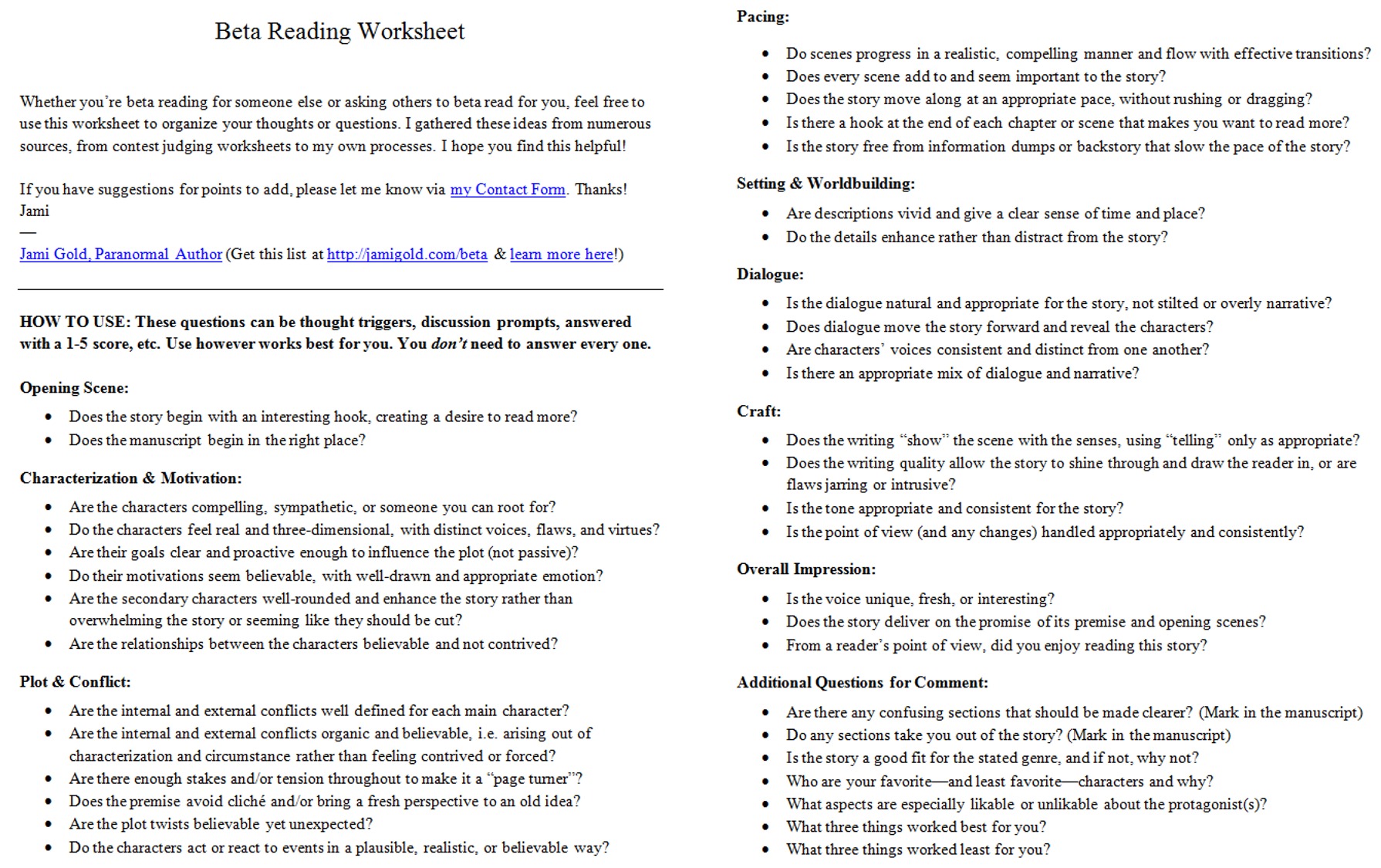
In Introducing the Beta Reading Worksheet, Jami Gold offers important tips, too. She works with fiction writers but her advice on beta readers applies to memoirists.  

  • “…Many of us find beta readers by offering to exchange our work with other writers in a ‘I’ll give you feedback if you give me feedback’ arrangement.” That way we offer our services, rather than money, for their services.
  • Jami describes A Bad Beta Reader,
  • and A Good Beta Reader, along with recommended “critique phrases” to use—don’t miss them!
  • What If We Don’t Know What to Look For or Ask About?
  • She also shares links to her Beta Reading Worksheet.


“I like to think of beta readers as sort of junior-grade editors,” writes K.M. Weiland. “They’re not full-fledged, bona-fide, paid-and-professional types…. But that doesn’t mean they’re any less savvy—or any less important.”

In her article, Why Non-Writers are the Best Beta Readers, K.M. says we usually recruit writers to serve as beta readers because they know the specialized aspects of writing well. But she warns us not to overlook non-writers.

She raves about the feedback she got from two non-writer beta readers. “I received two whoppingly good critiques… from non-writers…. Both …brought up concerns that my writing beta readers didn’t….”

Read K.M.’s post, Why Non-Writers are the Best Beta Readers, including her list, How to Choose a Non-Writing Beta Reader.


Kathy Pooler writes, “I value this beta reading phase and am very grateful to beta readers who volunteer to take time out of their busy schedules to provide me with their honest feedback and guidance….

“The beta reading process can be grueling because you want constructive feedback, but not everyone will agree with the content or quality of your writing and it does sting. However, I’d rather find this out before rather than after publication. I have learned to filter out the feedback that makes sense and disregard the rest. I try to keep an open mind because what I want most is to present my story in the best possible way.”

Click on Kathy’s Seven Tips for Hanging On To Your Voice Through the Editing Process to learn what we all need to do well: process feedback from beta readers and various editors.  

I hope you’ve found help from these recent posts on beta readers.  

Have you started lining up your beta readers?
Do you have tips to share with us?

Leave a comment below or a message on Facebook.


Tuesday, May 9, 2017

Tuesday Tidbit: Your memoir’s title


Last week we looked at giving your memoir a temporary, working title instead of a permanent title because the process of writing often takes the story places the author never expected. If that should happen to you, you’d have to change your title. (Click on that link to read last week’s post.)

While you write your memoir, in the back of your mind play around with possible title ideas.

When you’re close to finishing your manuscript, the time has come to get serious about choosing just the right permanent title.

Kathy Pooler offers good advice in her post, “Does Your Memoir Title Pack a Punch?” She lists questions she asked herself in crafting her memoir’s title: 
  • Is the title catchy?
  • Does the title strike at the heart of my story?
  • Does my title reveal my promise to the reader?
  • Does the title create interest for the reader?


For now, then, ask yourself Kathy’s questions and come up with a few potential titles for your memoir.


And there you have it: your Tuesday Tidbit.
We’ll have more tips on Thursday, so y’all come on back!

Tuesday, August 23, 2016

Tuesday Tidbit: Have you found your voice?


Here’s your Tuesday Tidbit, your 15 seconds of inspiration:


Many writers, especially new writers, struggle to find their “voice.” What does “finding your voice” mean?

It means writing the way you speak. Your goal is to make your writing sound authentic—to sound like yourself.

Jeff Hines says it this way: “You don’t need to search for unfamiliar language…. Simply be yourself and write the way you speak.”

“If it sounds like writing, I rewrite it,” says Elmore Leonard. “Or, if proper usage gets in the way, it may have to go. I can’t allow what we learned in English composition to disrupt the sound and rhythm of the narrative. It’s my attempt to remain invisible, not distract the reader from the story with obvious writing.” 


To read more of Theo Nestor’s thoughts on finding your voice, click on this link at Kathy Pooler’s blog.

To read more of Elmore Leonard’s advice to writers, click on Elmore Leonard’s 10 Rules of Writing.


Thursday, October 1, 2015

Who are the strategically placed people in your life?


Think about a person who made a positive impact on your life—a person who changed your life, whose life still ripples through yours today even if you live far apart, even if that person has died:

a soldier,
fireman,
grandparent,
preacher,
teacher,
singer,
supervisor,
janitor,
missionary,
neighbor,
doctor,
store clerk,
professor,
farmer,
policeman,
classmate,
teammate,
college roommate.

Perhaps even a stranger.

Or maybe a person from past generations:
a scientist,
artist,
pioneer,
sailor,
inventor,
explorer,
song writer,
spiritual leader,
writer,
world leader.

What, specifically, did she do that influenced your life?

What words did he say that made all the difference?

What good example did she live which inspired you to live in the same way?

How did his choices give you courage to shape yours?

How different would your life be without that person’s involvement?

Memoirist Kathy Pooler reminded us recently: “Hindsight seems to bring about new clarity and wisdom,” so take time—make time—to seek clarity and wisdom to discern how God has intentionally brought special people into your life.

You might not have recognized, back then, the significance of his or her mark on your life, so dig deep into your memory to detect how God worked through those relationships and experiences to make you who you are today.

Notice the ways God has used those people to protect you, maybe redirect you, and strengthen your faith.

Start writing even before you have remembered everything, before you know where your story is going and how it will end.

Why? Because much more hides within your experience than you realize right now. Writing leads to discovery. Roger Housden says it this way:

“…[A]s much as we think we know about our story,
there is far more waiting to surprise us
when our own words hit the page.”


So, write your stories!

Write them not as a hobby but as a ministry to your family.

Writing your memoir 
is a sacred work, 
a high calling, 
a divine project.

Your kids and grandkids and great-grands need to know about the people who invested in you and guided you—and probably even kept you from doing a few stupid things. Just think: Your stories could have a life-changing impact on your readers, passing the original blessings on to future generations.

“There are generations yet unborn
whose very lives will be shifted and shaped
by the moves you make
and the
actions you take today….”

Andy Andrews


Thursday, September 3, 2015

Does your memoir have a title yet?


Have you chosen a title for your memoir? You can give it a working title even if you haven’t finished polishing your stories.

Most of us spend a long time pinning down exactly the right title so start now on yours, knowing you might change it later.

Some of you don’t plan to publish your memoirs for a broader audience—you’ll print a few copies for family members. In that case, choose a fun title that they’ll enjoy. You’ll find good tips below.

If you want to publish your memoir for a broader audience, ask yourself the following when searching for your title:

  • What is my memoir’s theme or recurring themes—my memoir’s message?
  • What is my story’s major turning point?
  • Can I link my title to a popular book title? (The last time I checked, book titles cannot be copyrighted but, nevertheless, craft your own similar title.)
  • Is there a famous quote or Bible verse that summarizes my memoir’s message?
  • Who is my audience (who is most likely to buy my book)? Use key words to catch potential readers’ attention. 

Kathy Pooler offers good advice in her blog post “Does Your Memoir Title Pack a Punch?” In it, she leads us through steps she took in crafting her memoir’s title.

In choosing it, she asked herself:

  • Is the title catchy?
  • Does the title strike at the heart of my story?
  • Does my title reveal my promise to the reader?
  • Does the title create interest for the reader?

Jerry Waxler, in his blog post, “How to Pick the Best Title for Your Memoir,” says we need to “consider all the work a title has to do. A great title helps potential readers buy the book, love it to the last page and then recommend it to friends.”

Jerry says, “the title is the first line of marketing.” A title can make or break a sale.

Think about how you decide which books to buy: The first thing you notice is the title, right?

If the title doesn’t appeal to you, you put the book back on the shelf. You want a book that makes you curious, attracts you, draws you in, and makes it impossible to put the book back on the shelf.

If the title does grab your attention, then, if you’re like me, you read the back cover for more info, and you open the book and read endorsements that might be at the beginning of the book. But remember, it was the title that inspired you to do so. That’s why your title is so important.

Above, Kathy asks, “Does my title reveal my promise to the reader?” and Jerry says it this way: “Reading a book is like entering a contract with the author, and the terms of that contract are summarized in the … title. Every time a reader sits down to read, the title goes through their mind, evoking an image that pulls them back into the story.”

My first memoir had several working titles. I played around with Confessions of a Baby Boomer: Letters from Africa because the organization I worked with in Africa was interested in using the book to recruit Baby Boomers, empty-nesters, and mid-lifers. The words Baby Boomer are key words that could catch the attention of our targeted audience.

But that title didn’t feel just right. Next I tried out Quaint I Ain’t: Grandma’s Letters from Africa, because, from the book’s preface: 


“I discovered I was not the traditional, 
quaint little grandmother 
I always envisioned. 
No, I had stumbled into adventures 
most grandmas couldn’t imagine—
a hippo charged me, 
a baboon pooped in my breakfast, 
a Maasai elder spit at me, 
and I drank tea from a pot cleaned with cow’s urine.” 

But that didn’t feel right, either—to me or to those who knew me. “Ain’t” is a word I’ve never used, and some acquaintances were shocked that I would use it.

In the end chose Grandma’s Letters from Africa for two reasons: (1) The memoir was a collection of letters I wrote to my granddaughter, and (2) I hoped potential readers would connect my title with Karen Blixen’s (Isak Dinesen's) Letters from Africa. My husband and I lived near Karen’s home and coffee farm, both of which were central in the famous movie, Out of Africa. (Sigh….)

Next week we’ll continue looking at memoir titles, but in the meantime, choose a working title, knowing you might change it later. Your working title will help you discover your final title.

If you already have a working title or published title, share it with us and tell us how you chose it. Leave your comments below or on Facebook.

Come back next Thursday for more about choosing your memoir’s title.