Showing posts with label writing about hard things. Show all posts

Tuesday, May 23, 2023

Don’t start writing your memoir until. . .


 “Do you love?” asks Beth Kephart. “Are you still learning to love?”


“It’s a question . . . we must repeatedly ask ourselves, especially when we’re writing memoir.” (Handling the Truth: On the Writing of Memoir)


Beth, award-winning author of 23 books, including several memoirs, says:

  • if we don’t know what we love,
  • if we’re not capable of loving,
  • if we’re focused too much on self (“if we’re stuck in a stingy, fisted-up place”),
  • if we’re too angry,
  • if we haven’t allowed grace to take the edge off disappointments,
  • if “we haven’t stopped hurting long enough to look up and see the others who hurt with us,”
  • if we “only have words . . . for our mighty wounds and our percolating scars,”
  • . . . then it’s likely too soon to begin writing a memoir.


Beth says, “No memoir is worth reading if it is not leavened with beauty and love. And no memoirist should start her work until she can, with authority, write about the things she loves.”


She offers this starting point:


Make a list of little things that bring you happiness, those things that embrace beauty and goodness and love.


Beth’s not suggesting

you cover up your sorrows and wounds.


She says,


“Rest assured

you’ll be given a chance to tell the whole story soon.

But start, for now, with love.”


Read that again:


Beth’s not suggesting you cover up

your sorrows and wounds.


“Rest assured you’ll be given a chance

to tell the whole story. . . .

But start, for now, with love.”


Beth’s suggestion reminds me of Philippians 4:8, “Fix your thoughts on what is true and good and right. Think about things that are pure and lovely, and dwell on the fine, good things in others. Think about all you can praise God for and be glad about.” (The Living Bible)


The Message says it this way: “You’ll do best by filling your minds and meditating on things true, noble, reputable, authentic, compelling, gracious—the best, not the worst; the beautiful, not the ugly; things to praise, not things to curse.”


Eventually, you’ll likely include many types of vignettes/anecdotes in your memoir—adventure stories, sad stories, funny stories, heartbreaking stories, heartwarming stories.


By incorporating Beth’s suggestions,

by including love and gratitude,

writing your God-and-you stories

is a way to extend grace and mercy to others,

as well as to thank Him for all He has done for you.


Beth’s Handling the Truth: On the Writing of Memoir is a rich resource for you. Consider adding it to your library.


Come back next week: We’ll look at how to write about baggage-carrying people. 


Tuesday, January 11, 2022

“Don’t get rid of the pain until you’ve learned its lessons”


As you reflect on the past and write your memoir, you’ll need to examine painful experiences.


Even “happy” memoirs

will include an element of sadness

or displeasure or ache.


That’s because even the happiest lives include

challenges, disappointments, and obstacles.


Life includes an unwelcome surprise or two.

Heartaches, too.


And some lives include terrible suffering.


Writing about painful happenings can be agonizing because it requires you to relive the experience.


From a spiritual angle, we’re often tempted to question God, asking Him “Why?”  


Why would He make me wait so long for relief from a desperate situation?


Why does He allow my children or parents or spouse to suffer?


Why does God seem so distant and uninvolved in my life?


Why doesn’t God love me enough to do something?


Why did He allow a loved one to die?


But writing can also bring healing if,

in the process of writing,

you look at the hurtful incident carefully, dissect it,

and try to make sense of it

in ways you might not have in the past.


Jenn Soehnlin offers good advice in her article, “When you find yourself asking God ‘Why?’”


For a long time, Jenn had been asking God “Why?”  But, she writes, “One day . . . God was telling me I was asking the wrong question.


What other question is there? I wondered.”


Jenn continues, “I didn’t get an answer right away, but when it came, it shifted my perspective.


The question to ask was not “why?” but “what?” with a heart to learn God’s heart.


“For example, ‘What do You want me to learn from this . . . ? What good do You want to come from this?”


She continues, “By asking ‘what?’ instead of ‘why?’ it puts God back on His throne.


“Asking ‘what?’ suggests humility, trusting God.


“Asking ‘why?’ suggests a hostility toward God’s character, that He isn’t really good or cannot really be trusted, or a belief that we know better than the Creator Himself.


“It requires . . . an intentional decision to trust that God is teaching us something,” Jenn says, “and that it is for our ultimate good and the good of others around us, that we can impact others with what we’ve been learning.”


Did you catch that last bit? It could be that God has allowed painful things to happen for your ultimate good (such as spiritual growth and personal maturity—such as knowing God better and loving Him more), and for the good of other people—through your memoir.


Jenn writes, “It makes hard times a little easier to bear, knowing that there is something to learn—and one day, to teach and encourage others from what we learned during our hard circumstances.”


Jenn’s words are so wise, so good.

That’s why I always link writing memoirs

to 2 Corinthians 1:3-4: “The God of all comfort . . .  

comforts us in all our troubles, so that

we can comfort those in any trouble

with the comfort we ourselves have received from God.”


Reflection is such an important aspect of writing a memoir—and such an important aspect of loving and serving God. Many times in Scriptures, God tells us to remember what He did in the past for us and our loved ones.


Reflection: A time for re-evaluating assumptions we made in the past, for taking a fresh look at conclusions we came to in the past. A time for asking God “what?” instead of “why?”


Don’t get rid of the pain

until you’ve learned its lessons.

When you hold the pain consciously and trust fully,

you are in a very liminal space.

This is a great teaching moment

where you have the possibility of breaking through

to a deeper level of faith and consciousness.

Hold the pain of being human

until God transforms you through it.

And then you will be

an instrument of transformation for others.”

(Richard Rohr, adapted from

The Authority of Those Who Have Suffered)


Thursday, October 11, 2018

Don’t start writing your memoir until. . . .


“Do you love?” asks Beth Kephart in Handling the Truth: On the Writing of Memoir. “Are you still learning to love?”

“It’s a question . . . we must repeatedly ask ourselves, especially when we’re writing memoir.”

Beth, an award-winning author of 23 books, including several memoirs, says that if we don’t know what we love,

if we’re not capable of loving,

if we’re focused too much on self (“if we’re stuck in a stingy, fisted-up place”),

if we’re too angry,

if we haven’t allowed grace to take the edge off disappointments,

if “we haven’t stopped hurting long enough to look up and see the others who hurt with us,”

if we “only have words . . . for our mighty wounds and our percolating scars,”

then it’s likely too soon to begin writing a memoir.

Instead, Beth offers this starting point:

Make a list of little things that bring you happiness, those things that embrace beauty and goodness and love.

Beth’s not suggesting you cover up your sorrows and wounds.

She advises, “Rest assured you’ll be given a chance to tell the whole story soon. But start, for now, with love.”

Her suggestion reminds me of Philippians 4:8, “Fix your thoughts on what is true and good and right. Think about things that are pure and lovely, and dwell on the fine, good things in others. Think about all you can praise God for and be glad about.” (The Living Bible)

The Message says it this way: “. . . You’ll do best by filling your minds and meditating on things true, noble, reputable, authentic, compelling, gracious—the best, not the worst; the beautiful, not the ugly; things to praise, not things to curse.”

You’ll no doubt include many kinds of stories in your memoir—adventure stories, sad stories, funny stories, heartbreaking stories, heartwarming stories.

By incorporating Beth’s suggestions in each of them,
by including love and gratitude,
writing your God-and-you stories
is a way to thank Him for all He has done for you.

Beth’s Handling the Truth: On the Writing of Memoir is an excellent, rich resource for you. Consider adding it to your library. And check out her new website, Beth Kephart Books


Tuesday, October 2, 2018

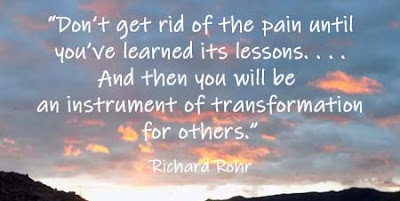
Tuesday Tidbit: Your memoir, "an instrument of transformation for others”


“Don’t get rid of the pain
until you’ve learned its lessons.
When you hold the pain consciously and trust fully,
you are in a very special liminal space.
This is a great teaching moment
where you have the possibility of breaking through
to a deeper level of faith and consciousness.
Hold the pain of being human
until God transforms you through it.
And then you will be
an instrument of transformation
for others. . . .”

(Richard Rohr, adapted from 
The Authority of Those Who Have Suffered)

That’s what 2 Corinthians 1:4 is about:

“[God] comforts us in all our troubles so that we can comfort others. When they are troubled, we will be able to give them the same comfort God has given us” (NLT).

That’s what your memoir can do for others.

How amazing is that?!


Be sure to check out these related posts:
  

Tuesday, September 25, 2018

Tuesday Tidbit: “Unveiling all the painful truths”


“Unveiling all the painful truths would expose my children,” writes memoirist Kathleen Pooler, “and I constantly asked myself:

“Do I have the right to do that? Will it be worth it? Will it affect our relationship as adults?

“I knew I could not publish this story without the full cooperation of both my children.”

And Kathy’s children, bless their hearts, did give their mother their full cooperation.

“The answers to those questions,” continues Kathy, “all came in due time as the years passed and distance helped us all sort through the many layers of feelings. . . .

“This may be my story but it is also their story. . . . I think of my memoir as a love letter to them.”

Wow. Read that again: “I think of my memoir as a love letter to them.”

Soon you can read Kathy’s second memoir, Just the Way He Walked: A Mother’s Story of Hope and Healing. Watch for it!

Read her entire blog post, The Dedication of My Second Memoir: A Mother’s Story, and be sure to follow her at Kathleen Pooler Author on Facebook.

We all have a lot to learn from Kathy.


Kathy reminds me of this Elisabeth Elliot quote. Kathy’s blooming! 
And her memoir will inspire you to bloom, too.

There you have it, your Tuesday Tidbit.


Thursday, January 22, 2015

Sneeze post

If you’re not following Spiritual Memoirs 101 on Facebook, recently you missed these and many more:

In How to Capture Your Toughest Memories, Amy Jo Burns says, “…the hardest scenes to write were also the ones that had been the hardest to live, and certainly the hardest to relive and remember. How do we begin to dissect the moments that changed the trajectories of our lives? These difficult scenes are often the most integral to our narratives, and they take time to develop and understand.…”

Do you want to remember more details to include in your memoir? Close your eyes and see what happens! Read more at Closing your eyes boosts memory recall, new study finds.

Following up on that idea, here’s a quick exercise Amber Lea Starfire developed to help memoirists remember sensory details—and yes, she is a fan of closing one’s eyes to retrieve those memories. This is a practical, helpful blog post. You’ll find the exercise at her blog post, From Memories to Memoirs, Part 3—Remembering vividly.

In Polish Your Prose, Nephele Tempest writes, “… the time will come when you need to edit.… I’m referring to that nitty gritty editorial process of looking at your work word by word, sentence by sentence, and examining the language you’ve used.” She offers storytellers and wordsmiths a cheat sheet to help with editing.

Patty Kirk offers another tool to help rework your stories: Read them aloud. “Hearing your sentences spoken lets you know whether they’re clear and natural-sounding—whether someone actually could speak them…. And it doesn’t work to read to an empty room. You need a warm body, a listener, to complete the communication.” Read more at Revising Aloud.

Happy writing!