Showing posts with label Richard Rohr. Show all posts

Tuesday, January 11, 2022

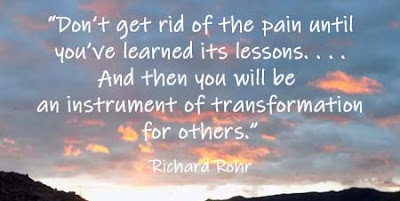
“Don’t get rid of the pain until you’ve learned its lessons”


As you reflect on the past and write your memoir, you’ll need to examine painful experiences.


Even “happy” memoirs

will include an element of sadness

or displeasure or ache.


That’s because even the happiest lives include

challenges, disappointments, and obstacles.


Life includes an unwelcome surprise or two.

Heartaches, too.


And some lives include terrible suffering.


Writing about painful happenings can be agonizing because it requires you to relive the experience.


From a spiritual angle, we’re often tempted to question God, asking Him “Why?”  


Why would He make me wait so long for relief from a desperate situation?


Why does He allow my children or parents or spouse to suffer?


Why does God seem so distant and uninvolved in my life?


Why doesn’t God love me enough to do something?


Why did He allow a loved one to die?


But writing can also bring healing if,

in the process of writing,

you look at the hurtful incident carefully, dissect it,

and try to make sense of it

in ways you might not have in the past.


Jenn Soehnlin offers good advice in her article, “When you find yourself asking God ‘Why?’”


For a long time, Jenn had been asking God “Why?”  But, she writes, “One day . . . God was telling me I was asking the wrong question.


What other question is there? I wondered.”


Jenn continues, “I didn’t get an answer right away, but when it came, it shifted my perspective.


The question to ask was not “why?” but “what?” with a heart to learn God’s heart.


“For example, ‘What do You want me to learn from this . . . ? What good do You want to come from this?”


She continues, “By asking ‘what?’ instead of ‘why?’ it puts God back on His throne.


“Asking ‘what?’ suggests humility, trusting God.


“Asking ‘why?’ suggests a hostility toward God’s character, that He isn’t really good or cannot really be trusted, or a belief that we know better than the Creator Himself.


“It requires . . . an intentional decision to trust that God is teaching us something,” Jenn says, “and that it is for our ultimate good and the good of others around us, that we can impact others with what we’ve been learning.”


Did you catch that last bit? It could be that God has allowed painful things to happen for your ultimate good (such as spiritual growth and personal maturity—such as knowing God better and loving Him more), and for the good of other people—through your memoir.


Jenn writes, “It makes hard times a little easier to bear, knowing that there is something to learn—and one day, to teach and encourage others from what we learned during our hard circumstances.”


Jenn’s words are so wise, so good.

That’s why I always link writing memoirs

to 2 Corinthians 1:3-4: “The God of all comfort . . .  

comforts us in all our troubles, so that

we can comfort those in any trouble

with the comfort we ourselves have received from God.”


Reflection is such an important aspect of writing a memoir—and such an important aspect of loving and serving God. Many times in Scriptures, God tells us to remember what He did in the past for us and our loved ones.


Reflection: A time for re-evaluating assumptions we made in the past, for taking a fresh look at conclusions we came to in the past. A time for asking God “what?” instead of “why?”


Don’t get rid of the pain

until you’ve learned its lessons.

When you hold the pain consciously and trust fully,

you are in a very liminal space.

This is a great teaching moment

where you have the possibility of breaking through

to a deeper level of faith and consciousness.

Hold the pain of being human

until God transforms you through it.

And then you will be

an instrument of transformation for others.”

(Richard Rohr, adapted from

The Authority of Those Who Have Suffered)


Thursday, April 23, 2015

“To remember only the pain, or only the joy, would be incomplete”


This month’s blog posts on Thursdays resulted from welcome comments Samantha White left after my blog post, Don’t Forget Your Memories!

If you’ve been hanging around SM 101 for a while, you know we emphasize the importance of remembering, based on several Bible verses, and Samantha’s probing ponderings brought real-life clarity to the topic.

With grace and wisdom, Samantha wrote, “Remembering can be a great gift and also a great curse. Memories can haunt us and pull us away from the present.…”

And so, her insight brings us to the end of this month’s examination of forgiveness and whether forgiving also means forgetting.

(If you missed earlier posts, here are links: Does forgiveness leave room for forgetting AND remembering?  We’ve all been there.  Is God’s grace is out of reach?) If we’re ready for “…a radical reconstruction of the heart,” (Max Lucado), God is ready and eager to forgive. God’s forgiveness is complete. Perfect. We also need to forgive ourselves.)  

So the question today is:

After God forgives us, after God takes our sins from us—as far as the east is from the west!—should we forget our wrongdoings? Or should we remember them?

Here’s what I think:

If remembering keeps us stuck in pain and regret,

if remembering prevents us from moving on,

if remembering keeps us mired in self-loathing,

if remembering our forgiven sins defines us and declares us ruined for the rest of our lives,

then remembering is not God’s best for us.

On the other hand,

if remembering focuses us on God’s unfailing love and all-sufficient grace,

if remembering makes us fall on our knees before Him in awe and thanksgiving,

if remembering speaks of  “a joyful release from the things that have bound us far too long” (Chuck Swindoll, Grace Awakening),

if remembering helps us hope,

if remembering blows us away,

if remembering shows how far God has brought us,

if remembering leads us to delight in God and love Him more,

then let’s remember!

God invites us to a sacred remembering,

a sacred remembering that releases us from wallowing in old history,

a sacred remembering that invites us to be our true selves: “Your True Self is who you are in God and who God is in you” (Richard Rohr, Immortal Diamond: The Search for our True Self),

a sacred remembering that enables us to live in the present, and for the future,

a sacred remembering that leads us to say, like David,

Let all that I am praise the Lord; may I never forget the good things he does for me. He forgives all my sins” (Psalm 103:1-2, NLT).

and, “You have changed my sadness into a joyful dance; you have taken away all my sorrow and surrounded me with joy. So I will not be silent; I will sing praise to you. Lord, you are my God; I will give you thanks forever” (Psalm 30:11-12, GNT).

 “Never be afraid when God brings back the past.
Let memory have its way.
God will turn the ‘might have been’
into a wonderful beginning for the future.”
(Oswald Chambers)

Forget the things that happened in the past.
Do not keep thinking about them.
I am about to do something new.
Don’t you see it coming?
I am going to make a way for you
to go through the desert.
I will make streams of water
in the dry and empty land.
  (Isaiah 43:18,19, NIRV)

God invites us to a sacred remembering in which we view our forgiven sins not as through rose-colored glasses, but as through grace-fogged glasses, when we view forgiven sins as distant clouds, as morning mists.

Samantha wrote these rich, insightful words that will bless your life and help you write your memoir:

“Memories can … make us deeply grateful for all the good we’ve received. One of the gifts for me in writing my memoir is that it helped me put my most painful memories to rest. By publishing them, I have given them wings on which to fly and stay alive, without my having to personally relive them daily.… The Bible is about times of pestilence and suffering AND triumph and survival. I suppose we need to remember it all … that life was difficult, and that we overcame and grew.… To remember only the pain, or only the joy, would be incomplete. We need to remember it all, as a package, because life is all of it. Pain and loss, healing and joy. We LEARN by remembering!!! I think the message of the Bible, ‘Remember,’ also means ‘Don’t let the suffering, nor what was gained and learned from it, be wasted. Learn. Remember what we’ve learned.’”


Many thanks, Samantha! 
You have blessed us all!


Thursday, November 29, 2012

“To remember only the pain, or only the joy, would be incomplete”


This month’s blog posts resulted from welcome comments Samantha White left after my blog post, Don’t Forget Your Memories!


If you’ve been hanging around SM 101 for a while, you know we emphasize the importance of remembering, based on several Bible verses, and Samantha’s probing ponderings brought real-life clarity to the topic.


With grace and wisdom, Samantha wrote, “Remembering can be a great gift and also a great curse. Memories can haunt us and pull us away from the present.…”


And so, her insight brings us to the end of this month’s examination of forgiveness and whether forgiving also means forgetting.

(If you missed earlier posts, here are links: Does forgiveness leave room for forgetting AND remembering? If we’re ready for “…a radical reconstruction of the heart,” (Max Lucado), God is ready and eager to forgive. God’s forgiveness is complete. Perfect. We also need to forgive ourselves.)

So the question today is:


After God forgives us, after God takes our sins from usas far as the east is from the west!—should we forget our wrongdoings? Or should we remember them?


Here’s what I think:


If remembering keeps us stuck in pain and regret,

if remembering prevents us from moving on,

if remembering keeps us mired in self-loathing,

if remembering our forgiven sins defines us and declares us ruined for the rest of our lives,

then remembering is not God’s best for us.


On the other hand,

if remembering focuses us on God’s unfailing love and all-sufficient grace,

if remembering makes us fall on our knees before Him in awe and thanksgiving,

if remembering speaks of  “a joyful release from the things that have bound us far too long” (Chuck Swindoll, Grace Awakening),

if remembering helps us hope,

if remembering  blows us away,

if remembering shows how far God has brought us,

if remembering leads us to delight in God and love Him more,

then let’s remember!


God invites us to a sacred remembering,

a sacred remembering that releases us from wallowing in old history,

a sacred remembering that invites us to be our true selves: “Your True Self is who you are in God and who God is in you” (Richard Rohr, Immortal Diamond: The Search for our True Self),

a sacred remembering that enables us to live in the present, and for the future,

a sacred remembering that leads us to say, like David,


“Let all that I am praise the Lord; may I never forget the good things he does for me. He forgives all my sins” (Psalm 103:1-2, NLT).


and, “You have changed my sadness into a joyful dance; you have taken away all my sorrow and surrounded me with joy. So I will not be silent; I will sing praise to you. Lord, you are my God; I will give you thanks forever” (Psalm 30:11-12, GNT).


 “Never be afraid when God brings back the past.
Let memory have its way.
God will turn the ‘might have been’
into a wonderful beginning for the future.”
(Oswald Chambers)

Forget the things that happened in the past.
Do not keep thinking about them.
I am about to do something new.
Don’t you see it coming?
I am going to make a way for you
to go through the desert.
I will make streams of water
in the dry and empty land.
  (Isaiah 43:18,19, NIRV)


God invites us to a sacred remembering in which we view our forgiven sins not as through rose-colored glasses, but as through grace-fogged glasses, when we view forgiven sins as distant clouds, as morning mists.


Samantha wrote insightful words that will bless your life and help you write your memoir:


“Memories can … make us deeply grateful for all the good we’ve received. One of the gifts for me in writing my memoir is that it helped me put my most painful memories to rest. By publishing them, I have given them wings on which to fly and stay alive, without my having to personally relive them daily.… The Bible is about times of pestilence and suffering AND triumph and survival. I suppose we need to remember it all … that life was difficult, and that we overcame and grew.… To remember only the pain, or only the joy, would be incomplete. We need to remember it all, as a package, because life is all of it. Pain and loss, healing and joy. We LEARN by remembering!!! I think the message of the Bible, ‘Remember,’ also means ‘Don’t let the suffering, nor what was gained and learned from it, be wasted. Learn. Remember what we’ve learned.’”


Many thanks, Samantha! You have blessed us all!