Showing posts with label writing memoir as ministry. Show all posts

Tuesday, June 14, 2022

When your life feels like an earthquake


Have you ever felt an earthquake?


I’ve experienced quite a few, but Seattle’s 1965 earthquake stands out. People felt it across Washington, British Columbia, Idaho, and Oregon. The 6.5 quake (some officials called it a 6.7) lasted 45 seconds, and that’s a long time for an earthquake of that magnitude.


Without warning, a jolt rocked our world. What had seemed solid and predictable and dependable suddenly lurched and crumbled.


And the earth’s eerie roar lasted even longer than that.


Sometimes life can feel like an earthquake.


Think about a time when something happened to you

and it felt like an earthquake struck.


Without warning, an unwelcome surprise shook your world.

What had seemed predictable and dependable

suddenly tilted and collapsed.

And even when the shaking stopped,

the eerie roar rolled on.


After the April 29, 1965 Seattle earthquake, countless structures had to be repaired and strengthened and, because of that, I added a new word to my vocabulary: Retrofitting.


Just about everything needed to be retrofitted: bridges, roads, buildings, chimneys, and equipment. That is, they needed not only repairs but significant modifications to lessen the damage if future earthquakes should strike. Often retrofitting required the development of new gizmos and doodads and technology.


After that earthquake, I remember all of us—my family, classmates, friends, neighbors, Seattle’s newspapers and TV stations—all of us relived the trauma, trying to process what had happened, amazed and thankful our damage wasn’t worse, worried that aftershocks or even bigger earthquakes would soon follow. Our talk and worry were like that eerie roar that kept up after the ground stopped lurching.


And, years later, another “earthquake” hit—my husband burst through our front door and announced he wanted to move our young family to South America so he could teach missionaries’ kids—and believe me, the earth beneath my feet felt like another major earthquake had struck and I literally fell to the floor.


In coming days and weeks and months, the eerie roar rumbled on. My dreams and plans had taken a hit. My sense of where my life was headed had fallen apart.


What I didn’t know then was that

the earthquake that my husband

(and eventually, it turned out, that God, too)

sprung on me was meant for good.

In fact, I would later learn

that some of my dreams and plans

weren’t the best for me and my family.

They needed to crumble down in ruins.

(Read more in my memoir,

Please, God, Don’t Make Me Go: A Foot-Dragger’s Memoir)


But I didn’t recognize that then. Instead, the stuff of earthquakes—like crumbled bricks and debris—covered me. It was dark down there. I felt bruised and broken. Alone.


I was only 27 years young. The old me now wishes I could have told the 27-year-old me that I could live a good life even after earthquakes and loss and the shock of it all.


As Christine Caine said,

Sometimes when you’re in a dark place

you think you’ve been buried,

but you’ve actually been planted.”


It would take me a couple of years to recognize that. The process included confusion, pain, waiting, and mystery.


Even though I struggled to recognize the specifics of God’s presence and guidance, deep down I knew He was working out my future.


That future would involve helping people who had nothing—nothing—of the Bible in their own languages. They had no way of knowing God and His goodness and involvement in their lives, especially when they, too, experienced life’s earthquakes and heaps of ruins.


But I—I did have God’s Word to stabilize me and give me hope. It tells me—and you, too—that He is present with us in our troubles and, “So we will not fear when earthquakes come and mountains crumble. . . . Let the mountains tremble . . . !”


And then He says, “Be still, and know that I am God!” (Psalm 46:1-11)


Wow! What a contrast: The earth trembles and splits and crumbles and roars, yet we are to be still. Still in God’s presence.


Be still and be assured:

He knows all about our lives’ tremors and jolts

and upheavals and lurches and joggles.

And He knows about the resulting broken pieces

and piles of rubble.


Be still and be assured: He repairs and rebuilds us,

retrofitting us to stabilize and strengthen us,

making modifications to lessen the damage

if other “earthquakes” should strike

all to make us beautiful, and useful to Him, in His time.

(Ecclesiastes 3:11)


What stories can you write about your life’s earthquakes?


Write about a time when, without warning, a jolt rocked your world. What seemed solid and predictable and dependable suddenly lurched and crumbled. Your dreams and plans had taken a hit. You felt bruised and broken. Alone. And even when the shaking stopped, the jarring trauma rolled on and on.


What Bible verses helped you survive?


Maybe, like me, you eventually discovered

that God had a hand in what happened,

and that He meant it for good.

Maybe, like me, you learned your plans and dreams

needed to crumble down in ruins.


Write about God’s retrofitting—the repairs He made,

the modifications He made in your life

to lessen damage from future shocks

that would come your way.


Write your story! Tell about the ruins.

Tell how God stabilized you and strengthened you.

Write how God brought good from it all.


Christine Caine also says thisGod is able to take the mess of your past and turn it into a message. He takes the trials and tests and turns them into a testimony. 


Someone needs to know your story.

It could make all the difference

in the way your readers handle their own lives

and endure their own earthquakes.


Tuesday, May 31, 2022

Your memoir might take up “residence in someone's soul” and become “their blood and self and purpose”


Do you recognize the opportunity you have—as well as the responsibility—to write your stories? Maybe right now you can’t imagine how God can use them to bless your readers—your kids, grandkids, and great-grands, friends, even strangers. But keep reading. . . .


Your stories are important. Writing them is more than a hobby—it is a ministry.


You and I are just ordinary people living ordinary lives, yet God is acting on our behalf every moment of every day.


Take time to observe what He is doing.


Notice the ways Bible passages come alive—how they come true, how they are relevant—in your family.


Remember our theme verse here at SM 101:


“Always remember what you’ve seen God do for you,

and be sure to tell your children and grandchildren!”

(Deuteronomy 4:9)


If you’ll put your stories into writing, you’ll be doing what Deuteronomy 4:9 urges all of us to do.


You have stories only you can tell.


“Someone needs to tell those tales. . . . For each and every ear it will be different, and it will affect them in ways they can never predict. From the mundane to the profound. You may tell a tale that takes up residence in someone's soul, becomes their blood and self and purpose. That tale will move them and drive them and who knows what they might do because of it, because of your words. That is your role, your gift. (Erin Morgenstern, The Night Circus)


Read Morgenstern's words again:

You may tell a tale 

that takes up residence in someone's soul

becomes their blood and self and purpose

That tale will move them and drive them 

and who knows what they might do 

because of it, because of your words

That is your role, your gift.


You are part of a story much bigger than yourself. Your story is part of God’s story and God’s story is part of your story.


Invest time and effort into connecting your stories with God’s stories. Don’t keep them to yourself—give them to others to read!


“We’ll tell our children what we’ve known

and what our ancestors handed down to us.

We won’t keep these stories to ourselves.

We’ll tell the next generation about God’s marvelous deeds.”

(Psalm 78:3-4)


Tuesday, April 12, 2022

Partnering with God in telling your story and His

 My computer is misbehaving so today's post will be brief. I hope . . . I trust . . . you'll find much to cherish in Diana Trautwein's quote below. 


Let it be your inspiration 

  • to begin your memoir,
  • or to keep writing your memoir,
  • or to finish writing your memoir!


Someone needs to know your story. 

It's important. 


Keep up the good work. 

Think of it as ministry, not a hobby. 

Offer it up to God as an act of worship.


Tuesday, April 5, 2022

How do you write about your family’s baggage?


Your ancestors and mine included a lot of fine people, but let’s be honest: Our family trees also include at least a few dysfunctional people—parents, grandparents, great-grandparents. Some carried out unhealthy practices and held offensive attitudes.


And now our generation has skeletons in the closet. Every family has baggage.


You know—the enabler.


Or the one who should have protected you but didn’t.


The bully, the controller, the know-it-all.


The petty one always looking for ways to take offense and blame you.


Your grandfather might have been a wife-beater.


Perhaps your father was quick to criticize and slow to praise.


Maybe your mother was egotistical and self-absorbed.


Your family tree might include a drunkard, a liar, murderer, adulterer, sex addict, drug addict, or a thief.


Even Jesus’ genealogical chart shows ill-famed characters: Rahab was a prostitute and King Manasseh deliberately defied God, carried out evil, and led God’s people astray.


Your family’s imperfect people have influenced you.


Some of the dysfunctional ones have played major roles in your life.


So, how should you, a memoirist, write about your people and their baggage?


First, examine your motive. That is all-important!


Hear this: Memoir is not about revenge.


Forbid yourself to use your memoir to shame people.


Refrain from humiliating anyone.


Refuse to get even.


Writing a memoir can bring much-needed healing

to you, the writer.


And writing can help break the cycle

of hand-me-down hang-ups

that crippled your family’s generations—


but focus on the right reason to write about your people.


“God’s Word clearly expresses

what a good and effective teacher the past can be.

The past will be a good teacher

if we will simply approach it as a good student,

from the perspective of what we can gain

and how God can use it for His glory.”

(Beth Moore, Breaking Free)


Do everything you must to be at peace with God:

  • Recognize that like your parents and grandparents, you have made and will make mistakes in your marriage, in raising children, and in relating to grandchildren.
  • Your malfunctions might be different from those of your parents or grandparents but, be assured, you have your own shortcomings and failures.
  • Ask for God’s forgiveness.
  • Accept His forgiveness.
  • Allow God to wrap you in His grace and mercy.


Wrapped in God’s grace and mercythat’s where you find peace with God.


Then pass it on: In writing your memoir,

you don’t need to act as if sins against you and others

were somehow okay.

They weren’t.

But I encourage you to extend to your ancestors

the same forgiveness, grace, and mercy God extended to you.


Read the following slowly, and then read it again. Take in its message:


“Thank God that

although you cannot change the past,

He can help you change what you’re doing with it!

And the changes He makes in you

in the present

can certainly change the future!

(Beth Moore, Breaking Free)


Tuesday, January 11, 2022

“Don’t get rid of the pain until you’ve learned its lessons”


As you reflect on the past and write your memoir, you’ll need to examine painful experiences.


Even “happy” memoirs

will include an element of sadness

or displeasure or ache.


That’s because even the happiest lives include

challenges, disappointments, and obstacles.


Life includes an unwelcome surprise or two.

Heartaches, too.


And some lives include terrible suffering.


Writing about painful happenings can be agonizing because it requires you to relive the experience.


From a spiritual angle, we’re often tempted to question God, asking Him “Why?”  


Why would He make me wait so long for relief from a desperate situation?


Why does He allow my children or parents or spouse to suffer?


Why does God seem so distant and uninvolved in my life?


Why doesn’t God love me enough to do something?


Why did He allow a loved one to die?


But writing can also bring healing if,

in the process of writing,

you look at the hurtful incident carefully, dissect it,

and try to make sense of it

in ways you might not have in the past.


Jenn Soehnlin offers good advice in her article, “When you find yourself asking God ‘Why?’”


For a long time, Jenn had been asking God “Why?”  But, she writes, “One day . . . God was telling me I was asking the wrong question.


What other question is there? I wondered.”


Jenn continues, “I didn’t get an answer right away, but when it came, it shifted my perspective.


The question to ask was not “why?” but “what?” with a heart to learn God’s heart.


“For example, ‘What do You want me to learn from this . . . ? What good do You want to come from this?”


She continues, “By asking ‘what?’ instead of ‘why?’ it puts God back on His throne.


“Asking ‘what?’ suggests humility, trusting God.


“Asking ‘why?’ suggests a hostility toward God’s character, that He isn’t really good or cannot really be trusted, or a belief that we know better than the Creator Himself.


“It requires . . . an intentional decision to trust that God is teaching us something,” Jenn says, “and that it is for our ultimate good and the good of others around us, that we can impact others with what we’ve been learning.”


Did you catch that last bit? It could be that God has allowed painful things to happen for your ultimate good (such as spiritual growth and personal maturity—such as knowing God better and loving Him more), and for the good of other people—through your memoir.


Jenn writes, “It makes hard times a little easier to bear, knowing that there is something to learn—and one day, to teach and encourage others from what we learned during our hard circumstances.”


Jenn’s words are so wise, so good.

That’s why I always link writing memoirs

to 2 Corinthians 1:3-4: “The God of all comfort . . .  

comforts us in all our troubles, so that

we can comfort those in any trouble

with the comfort we ourselves have received from God.”


Reflection is such an important aspect of writing a memoir—and such an important aspect of loving and serving God. Many times in Scriptures, God tells us to remember what He did in the past for us and our loved ones.


Reflection: A time for re-evaluating assumptions we made in the past, for taking a fresh look at conclusions we came to in the past. A time for asking God “what?” instead of “why?”


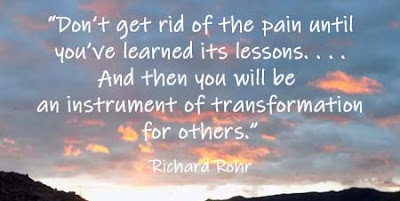
Don’t get rid of the pain

until you’ve learned its lessons.

When you hold the pain consciously and trust fully,

you are in a very liminal space.

This is a great teaching moment

where you have the possibility of breaking through

to a deeper level of faith and consciousness.

Hold the pain of being human

until God transforms you through it.

And then you will be

an instrument of transformation for others.”

(Richard Rohr, adapted from

The Authority of Those Who Have Suffered)


Thursday, March 14, 2019

“Your struggle to share your struggle"


Ya just gotta love Mick Silva and his ministry to writers. This quote of his is one of my favorites.


Yes, often you and I must struggle to share our struggles, but what a glorious result is possible! You and I can offer light to those in dark places. What a joy!

If you’ve ever been stuck in a dark place, I suspect you’ve never forgotten those who shared light with you. You've never forgotten how they changed your world.

Now it’s time to pass that on to others.

I’ll keep this post brief because I’m enjoying a visit from my son and granddaughter, but before I sign off, below you’ll find a couple of verses to bless and inspire you to keep on struggling to share your struggles. Remember, you and your memoir are light!

For you were once in darkness, but now you are light in the Lord. Live as children of light (for the fruit of the light consists in all goodness, righteousness, and truth). . . . (Ephesians 5:8-9, NIV)

But you are a chosen people . . . God’s special possession, that you may declare the praises of him who called you out of darkness and into his wonderful light. (1 Peter 2:9 NIV)

Remember: