Showing posts with label memoir as ministry. Show all posts

Tuesday, April 9, 2024

Write your memoir “on the cutting edge of what’s going on in God’s heart”


“In Raise Up A Standard—A Challenge to Christian Writers,

Michael Phillips asks,

‘Do we want to write

the sensational or the significant?

He challenges Christian writers

‘to be on the cutting edge, not of trends,

not of what’s going on in publishing . . .

but to be on the cutting edge

of what’s going on in God’s heart. . . .

If you believe in your message,

don’t give up on it.

Don’t water it down.

Don’t sensationalize it

just to get published

or to try to make it a best-seller.

Stand firm, in integrity and truthfulness,

for what God has given you to communicate.’”

(Eureka, CA: Sunrise Books, pp. 29-31).”

 (From Marlene Bagnull’s Write His Answer:

A Bible Study for Christian Writers.)


I like that: In writing memoir, let’s “be on the cutting edge of what’s going on in God’s heart.”


After all, here at SM 101, we consider our writing to be a ministry, not a hobby. (Be sure to click on Do you think of yourself as an ordained writer?)


Remember what Deuteronomy 4:9 says: “Always remember what you’ve seen God do and be sure to tell your children and grandchildren.”


And in Luke 8:39, Jesus said, “Go, tell your family everything God has done for you.”


Accomplishing that, however, can be a daunting task.


How can any mere human do what Michael Phillips said:

to know, and then to write, on the cutting edge

of what’s going on in God’s heart?


Henri Nouwen tells us how to begin, how to end, and how to accomplish everything in between. He uses the word “solitude.”


“. .  We are usually surrounded by so much outer noise that it is hard to truly hear our God. . . . We need to learn to listen to God, who constantly speaks but whom we seldom hear.”


We need, he says, “a life in which there is some free inner space where we can listen to our God and follow His guidance. . . .


Solitude begins with a time and a place for God,

and God alone. . . .

We need to set aside a time and space

to give God our undivided attention.

(Matthew 6:6)”

(Henry J.W. Nouwen, Making All Things New and Other Classics) 

(Also click on “Bringing Solitude Into Our Lives,

Excerpts from MAKING ALL THINGS New”.)


Always remember: Your story is important. God can use it to shape the lives of your children, grandchildren, great-grands, and anyone else who reads your story, including the “spiritual” children God has given you. Not all of us have children, but we all have “spiritual” children who look up to us and model their lives after ours—more than we realize.


You know from experience

how powerful other people’s stories can be.

Many of them inspired you,

opened new worlds,

sent you in different and better directions,

and made you who you are today.


Believe this:

Your story can impact your readers

in the same way.


While you write the rough draft of your memoir,

ask God to show you what He wants you to communicate.


Set aside time for listening to God for His answer.


Take Henri Nouwen’s advice:

Make time to spend quality time with God,

in solitude with Him.

Give Him your undivided attention.


And then write your stories.


Tuesday, January 30, 2024

Your memoir: full of grace and seasoned with salt


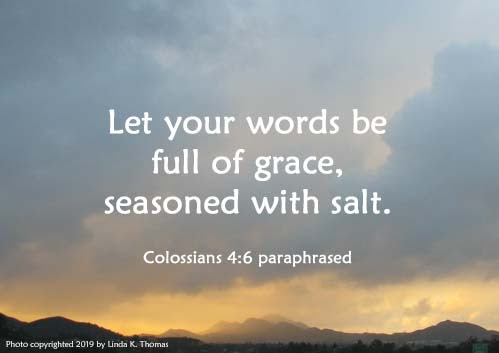
The Bible tells us to let our words be full of grace, seasoned with salt.


What does it mean for memoirists to use words that are seasoned with salt?


Salt purifies and preserves. In Bible times, because people didn’t have refrigerators, they used salt to keep their food from spoiling. Salt prevents rotting and waste.


Salt also heals. Have you ever had a mouth sore? Even a little tiny one can really hurt! If you sprinkle a few grains of salt on it for even a few seconds, you might be surprised at how quickly that sore will heal.


Salt also adds flavor and makes food tasty.


And it’s part of a healthy diet.  Salt “balances fluids in the blood and is vital for nerve and muscle function.” 


Think about writing your memoir while reading the following:


“Salt has little influence when sitting in a salt shaker.


“However, it is of great value once it is mixed, in the right proportions, in our food. When it is sprinkled on food—or, better yet, cooked into food—it transforms the food. . . .


“Salt then is a perfect metaphor for the people of God: We have the responsibility to transform the environment in which we find ourselves, just as salt transforms food.


“We are often few in number, but it is no matter. Just as a few grains of salt can make a big difference in food, so also a few faithful Christians can make a big difference in the world.” (from The Sermon Writer’s Biblical Commentary)


Jesus said believers are the salt of the earth (Matthew 5:13). That means you have a ministry to those around you.


We are called to speak the truth in love (Ephesians 4:15).


“Gracious words are a honeycomb, sweet to the soul and healing to the bone” (Proverbs 16:24).


Writing your memoir is a ministry, not a hobby.


“You are a seasoning agent. . . .

You can bring the distinctive flavor of God’s values

to all of life.”

(Theology of Life Project)


God can use your memoir

to do for your readers what salt does:

Your memoir can purify, preserve,

prevent wasted lives, add welcome flavor to life,

and keep your readers well-nourished and healthy.


In what specific ways can you write a memoir

full of grace, seasoned with salt?


Tuesday, November 28, 2023

Part 2: What can you offer readers about mourning AND thanksgiving?


. . . . Continuing from last time: How can you write accounts in your memoir that embrace both mourning and thanksgiving?


For some of you, Thanksgiving brings back the pain of a heartbreak you endured in the past at this time of year.

  • Every time Thanksgiving rolls around, you remember the first time you had to look at that empty seat at the Thanksgiving table. And it’s still empty this year.
  • That special person’s favorite song keeps playing in your mind.
  • Or Thanksgiving always reminds you of the time you miscarried . . . again.
  • Or someone shot you, leaving you paralyzed from the waist down.
  • Your boss fired you and you saw yourself as a total failure.
  • You remember Thanksgiving as a time of enduring the unimaginable, when you were crushed in spirit, unable to shake the heaviness.


It was a situation you never could have predicted or would have chosen.


Since then, you’ve struggled

to find joy in the Thanksgiving season. . . .


And yet . . . . And yet . . . .


Now, looking back years later, you recognize that

there’s more to your story.

Something to be thankful for.


In some unexpected, surprising way,

not only did you survive, but now

you acknowledge the silver lining of your heartache.


You came out on the other side of your sorrow

thanking God for the blessings wrapped up in the hurts.


He brought beauty from your ashes:

He gave you the oil of joy—a joyous blessing—

instead of mourning,

and a garment of praise

instead of heaviness and despair (Isaiah 61:3).


That’s what you want to put in writing

for your family and friends.


How did it happen?


If you haven’t sorted through that already, I encourage you to do so.


Take time—make time—to examine the past. Be deliberate.


Peel back layers and discover what you hadn’t noticed before.


How, specifically, did you travel from grief . . .

 to anger,

and then to hope . . .

and then to some degree of healing?


I say “some degree of healing” because most of us, despite the mending and restoring and rebuilding, still have an ache in our hearts.


You might be saying, “But I still have scars!”


I understand. I still have scars, too.


But a scar is not the same as a wound.


A wound is an injury, a laceration, a blow, a rip, a break.


But a scar is

“a mark left where a wound or injury or sore has healed.

(Oxford American Dictionary)


A scar is what you have after you’ve mended.

The bleeding has stopped. The scab has fallen off.


Instead of thinking of a scar as something damaged,

defective, or disfigured,

isn’t it better to see the scar as something that has healed?


Think of your scar as an emblem declaring you survived, as evidence of healing.


Take a good hard look at the way God answered prayers. You might not have detected them at the time, but looking back, you can clearly identify God’s specific answers.


Notice the people God brought into your life to shine a little light in your darkness.


What Bible verses popped off the page and gave you hope for the future?


  • Blessed are those who mourn, for they shall be comforted (Matthew 5:4).
  • The Lord is close to the brokenhearted, and He saves those whose spirits have been crushed (Psalm 34:18).
  • Those who go to God Most High for safety will be protected by the Almighty (Psalm 91:1).
  • He has put His angels in charge of you to watch over you wherever you go (Psalm 91:11).
  • They will call upon Me and I will answer them. I will be with them in trouble; I will rescue them and honor them (Psalm 91:15).
  • “I know what I am planning for you,” says the Lord. “I have good plans for you, not plans to hurt you. I will give you hope and a good future” (Jeremiah 29:11).
  • “At the right time, I, the Lord, will act. . . .” (Isaiah 60:22)
  • I give new life to those . . . whose hearts are broken (Isaiah 57:15b).
  • He heals the brokenhearted and binds up their wounds (Psalm 147:3).
  • Weeping may last through the night, but joy comes with the morning (Psalm 30:5b).
  • How long, Lord, must I call for help . . . ?  I will stand like a guard to watch . . . . I will wait to see what He will say to me; I will wait to learn how God will answer my complaint (Habakkuk 1:2, 2:1).
  • God knows where I am going. And when He tests me, I will come out as pure as gold (Job 23:10).


Note turning points or significant events.


During the early stages of what I call my personal 9/11, when I despaired of ever really living again, for some inexplicable reason I planted nasturtium seeds.


Shortly afterward, it occurred to me that that was a strange thing for a person to do who feared she might not survive. Would I live long enough to see those seeds sprout? Maybe even blossom?


Soon I was deeply moved by discovering that a seemingly insignificant activity—planting seeds—was an act of faith and hope for the future.


I clung to that tiny ray of hope day after day and, before long, nasturtiums began to bloom, and I was still alive, and the flowers were brilliant. Planting those seeds was a tiny but significant turning point for me—one of many.


Look at that green!

Let me tell you another beauty-from-ashes story. One day when my husband and I lived in eastern Washington, a wildfire raced through our part of the state, destroying mile after mile of crops, barns, farm equipment, and houses. In every direction, as far as we could see, the world was all ash.


But, to my surprise, a couple of days later I could see wee little green grasses sprouting up through the ruins. Mile after mile, I noted the lovely, hopeful green! My heart rejoiced! God had already begun the healing process. That, too, was a turning point for me.


What were your turning points, the pivotal moments?

Identify them as you write.


This next part is important:

Remember, your readers want to know

how you navigated

through your crisis

so they can do the same

when they go through their own unwelcome challenges.


They look to you as a role model.


You do that by including TAKEAWAYS for readers.


Do you remember what a takeaway is?


Next week we’ll cover takeaways. For now, work on your rough drafts, praying your way through the writing, and offering readers the gift of both mourning and thanksgiving.


Your story is going to be great! God is going to use it.


Tuesday, November 14, 2023

What can you offer readers about mourning AND thanksgiving?


Some of you remember a past Thanksgiving as a time of grieving. Heartache.


We tend to think of Thanksgiving as a joyous time, a warm time of enjoying loved ones and good food.


But memories of some Thanksgivings

might be just the opposite for you.


Perhaps a loved one was dying,

or you learned your cancer had returned.

Maybe someone dear to you committed suicide.

You lost your job.

Or your spouse left you.

Or an earthquake—

or hurricane or volcano or wildfire—

destroyed your town.


And now,

when Thanksgiving comes around each autumn,

you remember that season of sorrow.

And those memories hurt every time.


Five years ago this month, my daughter, son-in-law, and three grandkids somehow lived through an earth-shattering few weeks—along with hundreds of their friends and neighbors.


The Woolsey Fire started November 9, 2018, and burned for fourteen days, destroying almost 100,000 acres of the Santa Monica mountains and residential areas in Malibu along the Pacific Ocean. It would eventually destroy 1,643 structures.


Imagine them evacuating, driving away, fearing they’d never set eyes on their home again, wondering what could possibly remain of their close-knit community and of the church my son-in-law pastors. Imagine racing away, mile after mile, winds blowing flames out of control, and being overcome by enormous rolling clouds of smoke and ash.


No doubt you’ve experienced something

similarly destructive, emotionally or physically.

You know the ache, fear, alarm, hopelessness, panic.


And yet . . . And yet. . . .


Kaitlyn Bouchillon wrote of stepping into an unknown future, of having to “walk through what we never saw coming, walk among the ashes of what was or even, perhaps, will never be. . . .” (You know what that’s like.)


She wrote of shaky steps, unable to see more than one foot ahead, feet slipping. Of weariness, “slowly shuffling along for so long.”


And yet . . . looking back now,

Kaitlyn could see that was not the whole story.


Stacy L. Sanchez at Heartprints of God writes: “I have a question for you. What do you do when life doesn’t make sense? . . . When you are left with a million questions and not one single answer? What do you do?”


. . . “When we find ourself experiencing a trial or hardship, our humanness demands to know why. . . . Why me? . . . What did I do to deserve this? . . . Why would God allow this to happen? Why would a God of love let me suffer like this? Why didn’t God step in and do something to stop this?


Stacy continues, “Our questioning only leads to feelings of confusion, anger, or despondency, not the answer we are so desperately seeking.


“. . . During a very low point in my life . . . day in and day out I kept pleading with [God] for an answer. I believed if I could just understand the ‘why’ behind what was happening, I would be able to deal with it, accept it, and move on.”


But, “God remained silent. For months I wrestled with my emotions and my God.”


What about you?


What do you remember

of being nearly paralyzed,

broken by an unwelcome blow?

You recognized life would never be the same again.

Wondered how you could live with the pain.

Feared the future.

Doubted you could keep placing one foot

in front of the other.


And God remained silent.


And yet, looking back now,

you recognize that was not the whole story.


Ponder that this week.


Your mind will be at work while you rake leaves

and bring woolens out of trunks

and stoke up the fireplace fire.

And while you plan your Thanksgiving menu.

Believe me, more and more details

will pop into your mind.

You still have time

before Thanksgiving’s hustle and bustle

to jot them down.

You’ll be glad you did,

and someday your friends and family

will thank you.


We’ll continue this next time—

because there’s so much more to your story.


For now,

be thinking about what you can offer your readers

about mourning


but about more than that:

What can you also offer them

about thanksgiving—

about gratitude that eventually became

as life-changing

as the darkness?


Tuesday, October 24, 2023

Beyond entertainment: Challenge your readers to “do a doggie head-tilt”


You want to change your readers, not just entertain them.


Be sure at least some of your memoir’s stories challenge your readers to think.


Make them question.


Motivate them to stretch and wrestle with issues.


Move them to examine their assumptions and expectations to see if they’re valid.


Challenge your readers to do what Mike Metzger calls “a doggie head-tilt.” To look at things differently than before. Mike says, “If your head never tilts, your mind never changes.”


Persuade readers to tilt their heads and look at issues from another angle. To rethink what they believe. To reevaluate—and to maybe arrive at a different conclusion than they ever have before.


Open their minds to other possibilities, other interpretations, or other meanings.


Write stories that will give readers

a holy discontent with things that are not right in their lives

not to make them wallow in guilt,

but to offer them God-pleasing options.

James 4:8-10 comes to mind:

“Come close to God, and God will come close to you. . . .

Purify your hearts,

for your loyalty is divided between God and the world. . . .

Humble yourselves before the Lord,

and He will lift you up in honor.”

Also, see John 14:27.


Write stories that will give readers

a holy discontent with the ways of the world

materialism: possessions and trinkets,

meaningless mindsets and pursuits—and instead

inspire them to live lives of God-centered

substance and purpose.

Elaborate on what Jesus meant when he said,

“You do not belong to the world,

but I have chosen you out of the world” (John 15:19).

Also, see Romans 12:2.


The following prayer teems with ideas for your memoir:


Disturb us, Lord, when

We are too well pleased with ourselves,

When our dreams have come true

Because we have dreamed too little,

When we arrive safely

Because we sailed too close to the shore.


Disturb us, Lord, when

With the abundance of things we possess

We have lost our thirst

For the waters of life;

Having fallen in love with life,

We have ceased to dream of eternity

And in our effort to build a new earth,

We have allowed our vision

Of the new Heaven to dim.


Disturb us, Lord, to dare more boldly,

To venture on wilder seas

Where storms will show Your mastery;

Where losing sight of land,

We shall find the stars.


We ask You to push back

The horizons of our hopes;

And to push into the future

In strength, courage, hope, and love.

Attributed to Sir Francis Drake, 1577


Look at the first couple of lines: “Disturb us, Lord, when we are too well pleased with ourselves.”

  • What does “too well pleased with ourselves” mean to you, specifically?
  • What past events come to mind?
  • When were you too pleased with yourself? Or was someone else too pleased with himself?
  • What were the results of that mindset?
  • Why would/should we pray for God to disturb us over that attitude? What Bible verses illustrate that?
  • What lessons can you share with your readers?


Look at the next couple of lines: “Disturb us, Lord, when . . . our dreams have come true because we have dreamed too little.”

  • What does dreaming “too little” mean?
  • When did you, or someone you know, dream too little?
  • What was the result?
  • Why should we want God to disturb our wimpy dreams?
  • Tell readers the lessons you learned and how things could have been done differently. In this way, you are mentoring your readers.


Sift through your memories for stories that illustrate “Disturb us, Lord, when . . . we arrive safely because we sailed too close to the shore,” and when we focus on an “abundance of things.”


Then look at the third stanza.

  • When did a different you dare more boldly and venture into wilder seas where, as a result, storms showed you God’s mastery?
  • What can you write about “discovering the stars”?
  • You’ll want to explain what the following means: “wider seas,” “storms,” “God’s mastery,” “losing sight of the land,” and finding “stars.”


Remember,

writing your memoir is not just a hobby.

It’s a ministry.


God can use your story to guide, inspire, encourage, influence, motivate, and empower.


Sometimes a particular story, or version of a story, 

is so potent,” says Ayd Instone

that it becomes so interwoven in our lives 

that it defines the direction our life story takes 

and modifies behavior. . . .”


In a similar way, your memoir can change your readers.


Challenge them to “do a doggie head-tilt.


Be intentional. Make it happen.


Tuesday, October 17, 2023

Your memoir can have an outcome beyond your imagination


If you suspect your story isn’t worth sharing with others, this post is for you.


If you don’t recognize the influence your memoir can have, this post is for you.


If you can’t imagine how God can use your story, this post is for you.


Priscilla Shirer’s Bible study, Jonah, caught my attention in relation to memoirs.


She is certain that

in the same way other people’s stories

have encouraged and guided you

along life’s ways,

your story will do the same for others.


She asks us to think back to the Bible’s characters, pointing out that they


“may not have realized the privilege

and certainly didn’t know the eternal impact

they would make.”


Does that sound like your thinking, too?


“How could they have known

that their names would go down in God’s Word

to encourage us millennia later?”


Take to heart what Priscilla says here—take this personally:


Like those holy heroes, you’ve got an outcome you can’t make out. . . .” and:


“The fog of your life’s journey will clog your spiritual sight. . . .”


(Let me interrupt Priscilla here. That fog she refers to—that’s a holy fog. It keeps us from navel-gazing and pride. By God’s grace, He dims our self-absorbed vision in a blessed fog.)


Okay, back to Priscilla and this important point of today’s blog post:


In future generations, your story will be the one that encourages someone else to follow hard after God.”


Read that again and believe it:


In future generations,

your story will be the one

that encourages someone else

to follow hard after God.”


Priscilla’s insights give ideas for those who write memoir:


First, which Bible characters have impacted your life? Abraham? Joseph? Moses? Ruth? David? Esther? Peter?


What about other people—just ordinary people not in the Bible: a historical figure, a grandparent, a best friend, a spouse, a professor, a colleague, a coach. . . . The list could go on and on.


  • How did they point you to God? What did they tell you about His love for you, about His grace and mercy?
  • What did they say that helped define your life’s choices and values?
  • What did they do that influenced your life’s direction?


Craft vignettes illustrating why and how those people inspired you, guided you, and shaped you into the person you are today.


But don’t stop there. Don’t keep those stories to yourself. Look to the future. Pass on your stories—the blessings contained in them. Share your memoir with others, especially family members.


Always believe that in God’s hands, your stories are important.


Savor these rich words by Andrea Sanborn:


“In this autumn of my life, I have had to let go of the expectation that my physical body may one day may return to its youthful state. The added weight and wrinkles match my graying hair to render me on the downside of life’s trajectory.


“Now, like the falling leaves filling the woods around me, I hope to nourish others with the life given me; with the wisdom gained through the flourishing, green years now past.


“I think of the ones who sheltered and nurtured my seedling faith: the pastors and teachers, authors and leaders. I contemplate the ones who welcomed me, encouraged me, and prayed for me. The ones who parted the curtain into eternity before my hungry eyes.


Now it is mine to pass on the glimpses of glory that I have witnessed to the sapling souls around me.”


I hope you enjoyed Andrea’s words as much as I did.


Let me ask: Do you see your writing as a privilege? As a calling from God? Do you believe your memoir can have an eternal impact on others? How can future generations benefit from knowing your stories?


Always remember:


God can use your experiences,

joyful and sad, good and bad,

lovely and ugly,

funny and scary,

and He can use your words about them.


Together with God, your stories

can help readers cling to hope,

remain strong in their faith,

live in harmony in His ways,

and to delight in His love

now and forever.


When you realize God can use your memoir

in people’s lives,

your writing takes on

an altogether new meaning

and urgency.


Write your stories.