Showing posts with label beta readers. Show all posts

Tuesday, April 16, 2019

Tuesday Tidbit: It’s your time!


What kind of difference could you make, or do you want to make, or need to make, with the time you have left on this earth?


Here’s another question for you:

“ . . . How do you turn your dream of making a positive and meaningful difference in the world into a reality?”

Nina Amir asks the question and then she answers it for you: “You author change.

“You write and publish a book that inspires positive action or change. . . .

“The world needs change agents. It’s your time to make a positive and meaningful impact with your words.”

Your words, your storiesyour memoircould do that. It’s your time, Nina says.

It’s your time!

Not on your own, of course. No, every writer depends on numerous others to help in very practical ways, people in writing groups, critique partners, beta readers, editors, proofreaders, and the list goes on and on.

And then there’s God. Our main source—of inspiration, skill, tenacity—comes from God. Set aside a few seconds to take in this prayer:

“Gracious Father . . . 
I confess my total dependence on You 
not only for every breath I breathe, 
but also for every ingenious thought I think. 
You are the author of my vision and the instigator of my creativity. . . . 
You have chosen me to serve You. 
All my talents, education, and experiences 
have been entrusted to me by You. . . . 
Thank you in advance, Lord, for Your provision 
of exactly what I will need to serve You this day.” 
(Lloyd John Ogilvie, Quiet Moments With God)


May God bless you as you continue writing your memoir. 
It's your time!
Pray for His guidance and enabling. 

You probably can’t imagine all the ways 
He plans to use your story!


There you have it, your Tuesday Tidbit.

Thursday, June 22, 2017

You need beta readers!


We writers have a hard time recognizing our weaknesses or mistakes. We know what we want to say and believe we do so in the best way possible—but sometimes details in our minds don’t make it all the way to the written manuscript.

And some of us are weak on grammar, or story arc, scenes, openings, endings, writing with clarity, using dialogue, creating suspense, fleshing out key characters—and any number of other aspects of good writing.

We need beta readers! They let us know what works and what doesn’t in our manuscripts.

Mark Coker recommends we enlist between 12 and 30 beta readers. “You want readers who represent your target reading base, but you also want some diversity of opinion, so it’s okay to include readers who generally don’t read your category.”

Here’s another interesting tidbit from Mark: “…We found that the best feedback came from complete strangers who weren’t afraid to offend us.”

He offers several practical tips, for example: 

  • We can recruit beta readers on Facebook, Twitter, and other online groups.
  • We can ask our potential beta readers to pass the word on to their friends, “to create extra degrees of separation and to expand your readership.”
  • Use Google Forms to make applications for potential beta readers.
  • He shares a sample paragraph to use in the form’s introduction. 
  • Mark says, “before Google Forms, we provided readers with printed questionnaires within a printed manuscript. We placed questions after key chapters, as well as at the end…. Today…you can accomplish the same feat digitally by inserting hyperlinks to different Google Forms within key points of your book…[or] simply provide a final questionnaire at the end.”
  • Thank each beta reader with a personal email.
  • We don’t have to agree with or use all the feedback we get.

Don’t miss the resources in Mark Coker’s post, Making the Most of Beta Readers.


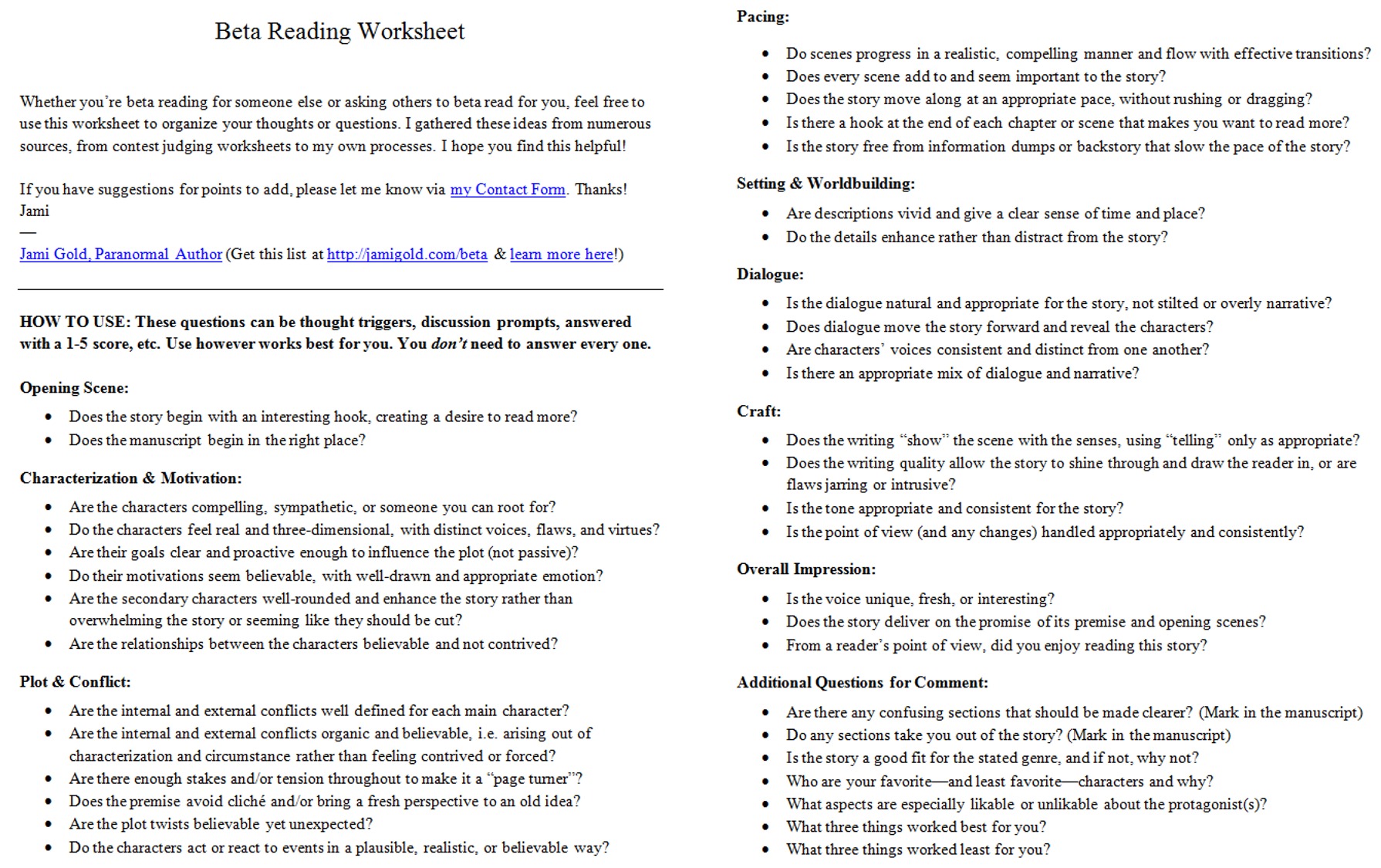
In Introducing the Beta Reading Worksheet, Jami Gold offers important tips, too. She works with fiction writers but her advice on beta readers applies to memoirists.  

  • “…Many of us find beta readers by offering to exchange our work with other writers in a ‘I’ll give you feedback if you give me feedback’ arrangement.” That way we offer our services, rather than money, for their services.
  • Jami describes A Bad Beta Reader,
  • and A Good Beta Reader, along with recommended “critique phrases” to use—don’t miss them!
  • What If We Don’t Know What to Look For or Ask About?
  • She also shares links to her Beta Reading Worksheet.


“I like to think of beta readers as sort of junior-grade editors,” writes K.M. Weiland. “They’re not full-fledged, bona-fide, paid-and-professional types…. But that doesn’t mean they’re any less savvy—or any less important.”

In her article, Why Non-Writers are the Best Beta Readers, K.M. says we usually recruit writers to serve as beta readers because they know the specialized aspects of writing well. But she warns us not to overlook non-writers.

She raves about the feedback she got from two non-writer beta readers. “I received two whoppingly good critiques… from non-writers…. Both …brought up concerns that my writing beta readers didn’t….”

Read K.M.’s post, Why Non-Writers are the Best Beta Readers, including her list, How to Choose a Non-Writing Beta Reader.


Kathy Pooler writes, “I value this beta reading phase and am very grateful to beta readers who volunteer to take time out of their busy schedules to provide me with their honest feedback and guidance….

“The beta reading process can be grueling because you want constructive feedback, but not everyone will agree with the content or quality of your writing and it does sting. However, I’d rather find this out before rather than after publication. I have learned to filter out the feedback that makes sense and disregard the rest. I try to keep an open mind because what I want most is to present my story in the best possible way.”

Click on Kathy’s Seven Tips for Hanging On To Your Voice Through the Editing Process to learn what we all need to do well: process feedback from beta readers and various editors.  

I hope you’ve found help from these recent posts on beta readers.  

Have you started lining up your beta readers?
Do you have tips to share with us?

Leave a comment below or a message on Facebook.


Thursday, June 15, 2017

Have you lined up your beta readers yet?


You want to publish a memoir of professional quality. That means you have lots of work to do. It also means you need to enlist the help of others also committed to professional quality.

Beta readers can serve as one of your most valuable resources—but what is a beta reader?

After you, the writer/alpha reader, do your best to polish your manuscript, a beta reader reads it and makes suggestions to help you make it even better before you send it off—to an editor if you plan to self-publish, or to an agent or editor if you hope to work with a traditional publisher.

Julie-Ann Harper defines a beta reader this way: “The term ‘beta’ is borrowed from the software industry, meaning the beta tests or reads your full manuscript to help you eliminate problems so you can improve its readability, its usefulness, and even its saleability before it’s published. Beta readers help with plot holes, clarity, pacing problems and of course mistakes.”

“Authors need beta readers to understand how people read their book and…to identify confusing or irrelevant spots,” writes Amanda Shofner. “Every author has weakenesses. You do, too—but you’re blind to them. Beta readers won’t be. And soliciting feedback from beta readers is your chance to address the weak spots of your manuscript…..”

Jami Gold explains, “Beta reading is not about the reader’s knowledge of the craft of writing, but about what works and doesn’t work for them as reader.”  She also says a beta reader “can offer feedback on big-picture aspects: story arc, character development, pacing, etc….” 

In her article, TheUltimate Guide to Working with Beta Readers, Amanda Shofner covers the following topics:
  • Why beta readers?
  • Who [do] you want as a beta reader?
  • How do you prepare your manuscript for betas?
  • What do you want from your betas?
  • How do you deal with feedback (without freaking out)?
  • How do you implement beta feedback?

K.M. Weiland lists seven things to look for in a beta reader. She says, “You want someone who:
  • Enjoys your genre.
  • Understands your intentions for your stories.
  • Likes our stories, in general.
  • Isn’t afraid to tell you what isn’t working.
  • Is an experienced reader and/or writer (both bring important insights…).
  • Is reliable and trustworthy.
  • You like—and who likes you in return.”

K.M.’s post also lists links for online communities to help you find beta readers. Don’t miss her article, 15 Places to Find Your Next Beta Reader.

Be sure to read Ann R. Allen’s excellent post, All About Beta Readers: 7 Ways They Can Improve Your Book. Though she often addresses writers of fiction, Ann’s points pertain to those who write memoirs, too. She covers the following:
  • I’m in a Critique Group—Do I Need Beta Readers?
  • Do Beta Readers Have to be Writers?
  • Should You Pay for Beta Readers?
  • Beta Read Exchanges
  • Tips for Authors in a Beta Read Exchange

Ann also offers 7 Valuable Things Beta Readers Do:
  • Find Repeated Words and Phrases and Confusing or Dropped Names
  • Flag Continuity Issues
  • Catch Dropped Storylines and Loose Ends
  • Alert Authors to Murky Motivation and “Unlikeable” Characters
  • Tell Authors When They’ve Lost the Plot
  • Fine-Tune “Sensitivity” Issues
  • Tell Us What Works!

The Write Life named Ann R. Allen’s blog as one of The 100 Best Websites for Writers for 2017. Be sure to check it out. You can also follow her on Facebook.

“Wattpad is a well-established website for finding beta readers. Scribophile is famous for the detailed and helpful critiques their members exchange. Beta Reader’s Hub is a source blog for beta readers.”

Beta readers, then, help you improve your manuscript so you can publish a quality memoir.  Their feedback allows you to make changes in private so that when your book is in print, you won’t be embarrassed in public.

For now, jot down a list of people who might agree to serve as your beta readers. Then come back next week for more info about finding and working with your beta readers.


Tuesday, September 6, 2016

Tuesday Tidbit: How to avoid public embarrassment


You’ve finished writing your manuscript, 
but before you are ready to publish
you have a LOT of work to do.  

That’s where critique groups
beta readers
and editors come in. 

Read more at 


Thursday, September 1, 2016

How do you find a good editor? What kind of editing do you need?


Last Thursday we considered publishing options. This week I’ve spent lots of time online looking at options for my next memoir. How about you?

Before you are ready to publish, though, you have a LOT of work to do. Most writers need to line up professional editing—often editors are busy and it’s good to get in line.  

But how do you find a good editor? What kind of editing do you need?

Look over the Editors Guild’s website about finding and working with an editor, costs, and types of editing:
  • developmental editing
  • substantive editing
  • copyediting
  • proofreading 

You’ll also find good tips in Elisabeth Kauffman’s Finding the Editor Who’s Right For You.

Before you send that manuscript off to an editor, do your own editing. The more you spiff up your manuscript, the less it could cost—some editors charge by the hour. If you submit a manuscript that’s the best you can make it, your editor can focus on other important parts of it. Why pay someone to do what you can do yourself?

(Critique groups and beta readers can be valuable beyond price in helping improve your manuscript and, frankly, they can keep you from embarrassing yourself in public. Read Belinda Pollard’s What is a beta reader and why do I need one? Also check out Valerie Comer’s blog post, Rewrite versus Revise versus Edit.  Many of us use the word rewrite—“from-the-ground-up rewrite”—when we mean revise. See “I like to rewrite. Sound crazy?”)

Like Ruth Harris said, “Editing can…turn an OMG-did-I-write-that? draft into a book you can be proud of.” Don’t miss Ruth’s 9 Ways Editors Can Make You Look Good…And 7 Ways They Can Make You Miserable. It’s packed with important info for you.

You’ll also find good insights in Karen Ball’s What an Editor Does: Peeling Back the Layers.

Be cautious in hiring an editor. “Though there are a lot of honest independent editors out there, you have to be diligent about looking for red flags,” according to The Writer’s Circle. For example, “If an editor doesn’t want to give out information about their credentials…or info about previously edited work then you have reason to be suspicious.” You’ll also find other excellent tips in How to Find an Independent Editor to Review Your Work.