Tuesday, August 30, 2022

Unveiling painful truths and moving to the other side of pain


“Unveiling all the painful truths [in my memoir] would expose my children,” wrote memoirist Kathleen Pooler, “and I constantly asked myself:

  • Do I have the right to do that?
  • Will it be worth it?
  • Will it affect our relationship as adults?


“I knew I could not publish this story without the full cooperation of both my children.”


And Kathy’s kids, bless their hearts, did give their mother their full cooperation.


“The answers to those questions,” continued Kathy, “all came in due time as the years passed and distance helped us all sort through the many layers of feelings. . . .


“This may be my story but it is also their story. . . . I think of my memoir as a love letter to them.”


Read that again: “I think of my memoir as a love letter to them.”


Can you, like Kathy,

write your memoir as a love letter

to your family and friends?

And even strangers?

Think about that.


Kathy admitted writing was painful and from that, she offers you this hope:


“When I first started writing out my stories, facing painful memories was difficult.


“As I kept writing, new insights revealed themselves to me just through the process of facing them and writing about them.


“I experienced healing through reading my own words and began to feel I was on the other side of the pain.”


Perhaps a similar experience happened to Henri Houwen, who wrote, “Often we discover the joy in the midst of sorrow.


“I remember the most painful times of my life” he said, “at times in which I became aware of a spiritual reality much larger than myself, a reality that allowed me to live the pain with hope. 


“I dare even to say: ‘My grief was the place where I found my joy.’”


Have you, too, discovered joy in the midst of your sorrow?

Has God helped you live with pain and hope

at the same time?


Perhaps you, like Henri Nouwen, can say,

“My grief was the place where I found my joy.”

(Henri Nouwen, Here and Now)


Kathy and Henri remind me of this Elisabeth Elliot quote:


“When you’re in a dark place, you sometimes tend to think you’ve been buried. Perhaps you’ve been planted. Bloom.”


Henri bloomed!


Kathy bloomed! And you’ll be inspired to bloom by reading her second memoir, Just the Way He Walked: A Mother’s Story of Hope and Healing.


Make time to think about Henri's words, 

and Kathy's words, 

and then write your stories. 

Someone needs to know them. 

Someone needs to grab hold of the hope you can offer.

Tuesday, August 23, 2022

And then I remembered the weevils that lived in that flour


 “I didn’t know you had these pictures, Mom!”


Matt’s face beamed. He grinned his biggest grin, spellbound by photos he held in his hands.


Hushed, he studied one snapshot after another.


“These will be great, Mom, to show my girls the people and places I’ve been telling them about all these years.”


Matt was talking about pictures I took in South America when he was age six through nine and our family lived in a remote mission center at the end of the road in the middle of nowhere.


Those were formative years for my boy. He experienced adventures most kids in North America couldn’t imagine, and they define the man he is today.


Because of Matt’s delight in discovering those old pictures, I scanned old slides by the hundreds, getting prints, scrapbooking them, and then placing them in three-ring binders among written stories from those years. (I told you about that last week and about the memoir I eventually wrote, Please, God, Don’t Make Me Go: A Foot-Dragger’s Memoir. Click on How one old photo led me to write a memoir.)


What are the takeaways for you?


Point #1: Include photos with your memoirs. Your children and grandchildren will be as delighted as my Matt was in seeing our old photos.


Point #2: Photos can help you discover, and then add, detail and richness and depth and breadth to your memoir—and those are important ingredients for (a) capturing readers’ interests and (b) helping them live your stories with you.


Readers can get inside your stories when you recreate them through the five senses—sight, sound, taste, touch, and smell. Photos can help you do that. (Remember Peter Jacobi’s words, “No story has a divine right to be read.”)


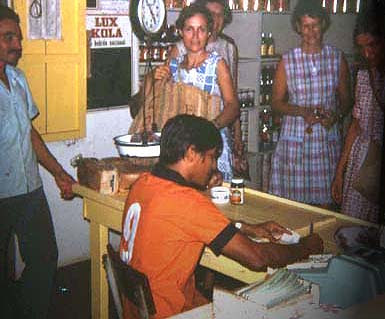
For example, here are two old, old photos of the little commissary at our mission center in South America. I’m wearing the red shirt. (Oh, my, I was much younger then. And slenderer.  Sigh . . . .)


When I stumbled upon those pictures many years later, I remembered the commissary’s smells: ripe, tropical fruit. Powdered laundry detergent. Broccoli. And rancid bread—if the bread man had come.


And then I remembered the burlap bags. Since we had no paper bags, one of our options was to lug groceries home in colorful locally made burlap totes. They were coarse and scratchy and had a dried-grass-burlap-ish smell.


And then I remembered the flour I bought at the commissary, hand-scooped (by someone, somewhere—I probably didn’t want to know the specifics) into tiny little plastic bags, usually a bit grimy.


And then I remembered the weevils that lived in that flour.


And then I remembered that at first, I didn’t know what to do about the weevils. I must have led a very sheltered life because I didn’t even know what weevils were, let alone that they could live in flour.


When I first arrived at the mission center, no one taught me that I could (a) put the flour in the freezer and freeze those little critters to death, or (b) spread the flour on a cookie sheet and bake them to death. Then all I had to do was sift out their lifeless little bodies.


And then I remembered that before I knew how to murder weevils, I fed them to a big crowd. I was asked to bring cinnamon roles to an event and, you guessed it—they were speckled inside with little black, crunchy dots—dead weevils. (You can read more in my memoir, Please, God, Don’t Make Me Go: A Foot-Dragger’s Memoir.)


See what I mean about the value of photos? I knew those stories—but I had forgotten them. I needed to rediscover them. Taking another look at those photos did that for me. And then I could include them and their stories in my memoir.


Sharon Lippincott, too, knows the value and joy of old photos. Reading her PhotographicMemory Jolts was pure enjoyment for me. From only one photo, she listed dozens of memories.


Take, for example, Sharon’s memories of saddle oxfords. Her post reminded me that every morning before school, I spent a lot of time polishing my own saddle shoes—the white part and the black part.


And I’d forgotten all about my Ivy League saddle shoes with the oh-so-cool little buckle on the back.


And then there was Sharon’s memory of Natalie Wood using Scotch Tape to keep her bangs in place while they dried. Yes, I did that too.


Sharon’s post is a fun read, a treasure trove of history especially if you’re around my age—and all from just one photo!


How about you? Pull out an old photo related to one of the stories in your memoir.


  • What emotions does it stir up?
  • What songs were popular at that time?
  • What styles of clothing, eyeglasses, hairstyles, shoes, furniture, and architecture does the photo capture?
  • Does the photo raise questions?
  • What happened just before the photo was taken? Just afterward?
  • Was something significant brewing at the time, even if you didn’t know it until later?
  • In later years, what happened to the people in the photo?
  • Does it remind you of additional stories?


Go beyond looking at your old photos. What smells come to mind? Textures? Sounds? Tastes? Sights?


Listen. Smell. Feel. Taste.


Relive.


Unravel.


I have a hunch you’ll discover details that will add gusto to your stories.


Have fun!


Tuesday, August 16, 2022

How one old photo led me to write a memoir


Last week we considered photos—rich resources to help you write your memoir. I mentioned that:


. . . years ago, I put photos

in three-ring binders

—photos from three years

our family spent in South America

when my kids were ages five and almost seven.


I also typed stories from letters

I’d sent my parents,

adding them to the photos.


I thought the story was finished

—until one day I noticed something

in one picture,

something I hadn’t noticed before.


It was a photo I took on Day One at our new home in South America, and it’s always been one of my favorites. I’d framed it and it was hanging on the wall. A magnet held another copy on my refrigerator. I had made copies of that picture and passed them out during speaking engagements.


But that day, long after I’d assembled the scrapbook, I saw in that photo something deeper and broader. The earth lurched when I recognized it, and I asked myself,


Why did you never notice this before?


After pondering that question, this became clear: In the letters to my parents, I never told them about the dangers, the scary stuff.


That meant the narrative in the scrapbook, based on those letters, was a list of selected facts, just the everyday surface stuff.


And with that realization,

I knew my story was incomplete—

not yet finished.


That photo foreshadowed stories that made ongoing international news—events that touched our family and friends and changed many lives forever.


I had a bigger, deeper, richer story to write—a story about hostility from guerrilla groups—their bombings, ongoing threats of violence, kidnappings, and murders—and what God and courageous people did in the midst of it all.


So I got to work, and those stories

soon resulted in my published memoir,

Please, God, Don’t Make Me Go:

A Foot-Dragger’s Memoir.


Enough about my discovery and my story. What about you?


Did you examine one or more key photos related to your story?


Reread last week’s post, Photos: A rich resource for writing your memoir, and peel back layers, asking yourself:

  • What is the deeper story behind this photo?
  • What is the deeper story about the people in the photo?
  • What is the bigger issue?
  • Does the photo symbolize or capture a theme in my memoir?
  • Does it contain a secret or solve a mystery? If so, do others now need to know about it? (If someone would benefit—if that would help heal an old wound, right a wrong, or bring forgiveness or hope—think and pray about revealing it.)


Maybe you still haven’t pinned down the real meaning, the central idea or message of your memoir. Perhaps a photo will help you discover it.


For a few days,

think about a key photo

and what it represents.


It might hold more significance

than you now realize.


Tuesday, August 9, 2022

Photos: A rich resource for writing your memoir


Photos can play a big role in your memoir. Among other things, they help you, the writer, remember details. But they can also help you recognize big stuff, the deeper story, the weighty repercussions.


Don’t believe me? I discovered something profound in an old photo, something I’d never noticed before, which propelled me into writing my most recent memoir, Please, God, Don’t Make Me Go: A Foot-Dragger’s Memoir. (More about that next week.)


Because of that experience, I encourage you to dig out a key photo related to your story. Examine it and jot down what comes to mind.


Let’s start with the easy stuff: 

  • When was the photo taken?
  • Why were you in that place?
  • What did you do there?
  • What was the weather?
  • Who was with you? If it’s a main character in your memoir, note his or her relevant characteristics: physical appearance, quirks, tone of voice, attitudes, values, talents, endearing qualities, maybe even odors.
  • What emotion does the photo stir up?

Jot down sensory details: What did you smell? What did you hear? Taste? Touch/feel? See?


Next, dig deeper. Look at those photos with fresh eyes. Read between the lines. What’s lurking (or percolating) under the surface? What are the vibes? Is there an elephant in the room?


How did the event or place or person in the picture:

  • change you?
  • or prepare you for the future and make you the person you are today?
  • warn you?
  • inspire you?
  • make your dreams come true?
  • break your heart and your spirit?
  • send you in an altogether new direction?


But don’t stop there. What’s the bigger picture?


Does the photo symbolize or capture the theme in your memoir? —the central idea or meaning or message? Ask yourself, What is the big picture here? What’s my story about?


For a few days, think about the photo and what it represents. It might hold more significance than you now recognize.


Here’s my experience: Years ago, I used three-ring binders to compile photos of our family’s three years in South America, and the stories that went with the photos, as keepsakes for my kids.


I assumed I had tied everything together and that the story was complete. But I was mistaken.


“Sometimes you think a story is completed

and all wrapped up.

But then, decades later, something happens

and you realize that it’s not done yet,

it’s still in process.”

(Lawrence Kushner,

Invisible Lines of Connection: Sacred Stories of the Ordinary)


Decades later, I looked at one of the photos—one of my favorites, one I’ve framed, one I’ve used in speaking engagements. That day I looked at it and saw something I’d never noticed before.


Why had I never seen it?


And suddenly I knew there was much more to my story than what I’d included in the scrapbook for my kids. 


Come back next week and I’ll tell you how that old photo took my three-ring binder accounts and transformed them into my recent memoir, Please, God, Don’t Make MeGo: A Foot-Dragger’s Memoir.


Between now and then,

look at a couple of photos pertaining to your memoir.


Perhaps you, too, will find clues that shout,

“Your story is not yet finished!”


Tuesday, August 2, 2022

When you didn’t even know God was there: Discovering His fingerprints


As you compose your memoir, take special note of what God was doing—even if at the time, His role was under the radar.


Maybe what you thought was a mere coincidence was much more—it was God Himself intervening.


Lloyd Ogilvie writes about the parable of the Good Samaritan and the phrase “now by chance” in Luke 10:31-35:


“Now by chance a priest was going down the road,” as was a Levite after him, and a Samaritan after him.


Ogilvie writes:


“The Greek word translated by the word ‘chance’

means ‘coincidence.’

But not even that word gets at the core of the meaning

of the Greek word. . . .

It means a confluence of circumstances

which seem to happen by chance

but are really events interwoven

by divine providence

for the accomplishment of a greater purpose.”

(Silent Strength for My Life)


Read that again.


In writing your memoir, look for occasions when something seemed to happen by chance or seemed coincidental. Ask yourself: Were they, in reality, “events interwoven by divine providence”—by God’s foresight and guidance and plan?


Give yourself plenty of time to search for answers.


Remember what makes memoir so rich, so special. A memoir goes beyond writing about what happened.


It involves discovering the significance of what happened

and what you did about it or with it.


Reflection is a key ingredient in writing a memoir. Most people need to work on reflecting because, as Richard Foster observes, “The sad truth is that many authors simply have never learned to reflect substantively on anything.”


The remedy?


To reflect in a meaningful, deliberate way.


Take a closer look at the incidents in your life, your decisions, your relationships:


  • Consider
  • Ponder
  • Contemplate
  • Deliberate
  • Ruminate
  • Cogitate
  • Wonder
  • Mull over
  • Chew on
  • Wonder about
  • Think about
  • Weigh
  • And study


Spend as much time as you need to make sense of what you discover—to pinpoint those aspects of your life that were indeed not just coincidence, not just something that happened by chance, but were in fact the work of God.


This week search for any of God’s fingerprints you might have overlooked in the past. Put in writing how your life changed as a result. How did God use the event to prepare you for the future? Deepen your faith?


Think about what Jacob said in Genesis 28:16,


“God was in this place and I wasn’t even aware of it.”

When has that happened in your life?


Uncover the richer, higher, deeper, wider, broader story,

the story of what God was doing.


Discovering that will change your heart and life

in ways you can’t imagine!


Tuesday, July 26, 2022

“Before you can write clearly, you have to be able to think clearly”


You labor and toil to write your memoir and place it in the hands of others. I know you do—because I’ve done it myself. Twice. I want to encourage you: If you persevere, in the end, you’ll find your effort worth it!


Remember significant motivations for telling your story: You want to bless your readers in any number of ways—you want your story to inspire them in their lives:

  • to never give up, never quit fighting, and always hope
  • to make good choices and be trustworthy people of integrity
  • to speak up when something’s not right
  • to always love, always forgive, and always extend grace
  • to grow in their faith
  • to laugh and love—to love God and others. 

The list goes on and on.


But all that depends on whether they can understand—really understand—your message. That’s why lately we’ve been talking about clarity. We need to write clearly and concisely if we want readers to (a) read our memoirs and (b) understand them—to get all the richness and wisdom and blessing out of them.


That means you and I need to find—have a good grip on—that clarity ourselves first.

Sometimes that’s a problem.

I’ve read thousands of passages

written by others in rough draft form

and it’s very revealing. And convicting.


Because here’s the deal: In reading someone else’s writing, we spot all the gaps in communication, the ambiguities, the words and sentences that leave us confused.


When that happens, I stop and re-read sentences, paragraphs, and maybe even pages, trying to make sense of the writer’s message, trying to figure out what his point is.


Here’s what I’ve learned: The writer doesn’t always know what he’s trying to say. (And by the way, that makes it pretty much impossible for me to edit or critique the person’s writing.)


Jesse Hines says it this way: “Before you can write clearly, you have to be able to think clearly. A big reason [writers fail to convey] their message is that they were not focused on a clear message. Good writing usually stems directly from clear thinking.”


Ask yourself, then, “Am I thinking clearly?”

  • Do you know the point of the paragraph you’re writing? What purpose does it serve?
  • Where do you want it to take your readers—that is, does it take readers from one significant point to the next significant point? In the right order?
  • Does the passage hold relevance for the main point of the larger vignette or experience?


If you’re confused, your readers will be confused, too.

Outlining your paragraphs

(the ideas and points within each)

should help you think more clearly,

rearrange words and sentences, and delete others.


Figuring out what you want to say is only the first step. Next, you need to write with clarity.


“Take great pains to be clear,” wrote C.S. Lewis. “Remember that though you [can] start by knowing what you mean, the reader doesn’t. . . . It is terribly easy just to forget that you have not told the reader something he wants to know—the whole picture is so clear in your own mind that you forget that it isn’t the same in his.” (C.S. Lewis, Writing Advice, “To a Schoolgirl in America”)


Think clearly, write clearly.


Tuesday, July 19, 2022

In penning your memoir, don’t “discount simple writing”


Last week we considered how important it is for you to communicate clearly with your readers. (If you missed it, click on Put yourself in your readers' shoes.)


This week I have tips for you on how to accomplish that.


Years ago, when I studied journalism, instructors taught us to aim our writing at eighth graders—that is, to write material that eighth-grade students can easily understand.


Recently I saw the same advice so it must still be the best practice.


What’s true for journalists is true for memoirists: Aim at an eighth-grade audience.


Ken Follett, Welsh author, says his goal is to make his prose “utterly easy to understand.” He calls it “transparent prose.”


“I’ve failed dreadfully,” Follet says, “if you have to read a sentence twice to figure out what I meant.”


Write clearly.

Concisely.

Transparently.

Simply.


Shane Snow says it this way: “We shouldn’t discount simple writing, but instead embrace it. . . .


“We should aim to reduce complexity in our writing as much as possible.


“We won’t lose credibility in doing so,” Shane says. “Our readers will comprehend and retain our ideas more reliably. And we’ll have a higher likelihood of reaching more people.”


“Writing text that can be understood by as many people as possible seems like an obvious best practice,” write Rebecca Monteleone and Jamie Brew. “But . . .


“ . . . from news media to legal guidance to academic research, the way we write often creates barriers to who can read it. Plain language—a style of writing that uses simplified sentences, everyday vocabulary, and clear structure—aims to remove those barriers.” (Read more at “What Makes Writing More Readable?”)


Read your manuscript aloud.

Listen for words or sentences or paragraphs

that could confuse readers.


Rewrite them,

fixing anything that’s not precise.

Make your writing easy to understand.

Your readers will thank you.


Come back next week. We’ll look at additional ways to write your memoir with clarity.