Showing posts with label Matthew 10:27. Show all posts

Tuesday, January 14, 2020

“Look where you have not had the heart to look before”


“Every once in a while, life can be very eloquent.
You go along from day to day
not noticing very much,
not seeing or hearing very much,
and then all of a sudden, something speaks to you
with such power
that it catches you off guard,
makes you listen whether you want to or not.
Something speaks to you out of your own life
with such directness
that it is as if it calls you by name and forces you to look
where you have not had the heart to look before,
to hear something that maybe for years
you have not had the wit or the courage to hear.”
(Frederick Buechner, Secrets in the Dark; emphasis mine)

Writing your memoir can be like that: Within the reflecting and pondering and excavating and decoding, something pops up, something  breaks you right open and “forces you to look where you have not had the heart to look before.”

You can no longer ignore it, hoping it will disappear. You know in your heart of hearts that you can’t turn away.

You’ve arrived at a defining moment.

If, in writing your memoir, you unexpectedly “hear something that maybe for years you have not had the wit or the courage to hear,” recognize that God is doing something profound.

Set aside time and make a serious effort to listen for God’s still small voice. Be willing to search your soul. God can help you make sense of what you're hearing and make peace with it.

Initially, you might not welcome that process, but it can be good and valuableif you give God your undivided attention for as long as it takes.

By breaking you open, God can help you break through to a higher, wider, deeper place of faith and joy in Him.

God can open your eyes to see events and relationships in new ways. He can give you a more accurate understanding of His love for you: You are beloved and secure in Him (Deuteronomy 33:12), He takes great delight in you, quiets you in His love, and rejoices over you with singing (Zephaniah 3:17).

Getting there can be a long and painful process, but if you stick with God and search the Bible and listen and pray, He can shine light on your darkness. He can give you a new song to sing.

Take in these words of dear David, the psalmist:

I waited patiently for the Lord to help me,
and He turned to me and heard my cry.
He lifted me out of the pit of despair,
out of the mud and the mire.
He set my feet on solid ground
and steadied me as I walked along.
He has given me a new song to sing,
a hymn of praise to our God
(Psalm 40:1-2, NLT)

When that happens—when God brings you to that good, new place—resume writing. Consider your memoir your new song of praise.

“It is through memory that we are able to reclaim much of our lives that we have long since written off by finding that in everything that has happened to us over the years, God was offering us possibilities of new life and healing, which, though we may have missed them at the time, we can . . . be brought to life by and healed by all these years later.” (Frederick Buechner, Telling Secrets; emphasis mine)

So, marvel at God’s goodness. Cherish His grace.

Use your memoir to:

Sing a new song to the Lord! . . .
Publish His glorious deeds. . . .
Tell everyone about the amazing things He does.
(Psalm 96:1-3, NLT)


Tuesday, June 6, 2017

Share what you discovered in the dark


All of us have experienced heartbreak, grief, and anguish, but too often we avoid writing about them.

How about you? Have you avoided writing the painful stuff?

Which of your stories remain untold?

If you’ll make an effort to write them, you and your readers will receive blessings beyond your imagination. 

Did you miss Thursday’s post on writing about your pain? If so, click on Writing Your Untold Stories.


Thursday, April 21, 2016

“Look where you have not had the heart to look before”


“Every once in a while, life can be very eloquent. 
You go along from day to day
not noticing very much,
not seeing or hearing very much,
and then all of a sudden, when you least expect it,
very often something speaks to you 
with such power
that it catches you off guard,
makes you listen whether you want to or not.
Something speaks to you out of your own life
with such directness
that it is as if it calls you by name and forces you to look
where you have not had the heart to look before,
to hear something that maybe for years
you have not had the wit or the courage to hear.”
(Frederick Buechner, Secrets in the Dark
emphasis mine)

Writing your memoir can be like that: Within the reflecting and pondering and exploring and decoding, something pops up, something breaks you right open and “forces you to look where you have not had the heart to look before.” You can no longer ignore it, hoping it will disappear. You know in your heart of hearts that you can’t turn away. You’ve arrived at a defining moment.

If, in writing your memoir, you unexpectedly "hear something that maybe for years you have not had the wit or the courage to hear," recognize that God is doing something profound.

Set aside time and make a serious effort to listen for God’s still small voice. Be willing to do some soul-searching. God can help you make sense of it and make peace with it. He can give you a new outlook on life, new purpose, new opportunities.

Initially you might not welcome that process, but it can be good and valuableif you give God your undivided attention for as long as it takes

By breaking you open, God can help you break through to a higher, wider, deeper place of faith and joy in Him.

God can open your eyes to see events and relationships in new ways. He can give you a more accurate understanding of His love for you: You are beloved and secure in Him (Deuteronomy 33:12), He takes great delight in you, quiets you in His love, and rejoices over you with singing (Zephaniah 3:17) .

Getting there can be a long and painful process, but if you stick with God and search Scriptures and listen and pray, He can shine light on your darkness, He can give you a new song to sing.

Listen to the words of dear David, the psalmist:

I waited patiently for the Lord to help me,
            and he turned to me and heard my cry.
He lifted me out of the pit of despair,
            out of the mud and the mire.
He set my feet on solid ground
            and steadied me as I walked along.
He has given me a new song to sing,
            a hymn of praise to our God. 
(Psalm 40:1-3, NLT)

When that happens—when God brings you to that good, new place—write the rest of your memoir. Consider it—your memoiryour new song of praise.

“It is through memory that we are able to reclaim much of our lives that we have long since written off by finding that in everything that has happened to us over the years God was offering us possibilities of new life and healing, which, though we may have missed them at the time, we can … be brought to life by and healed by all these years later.” (Frederick Buechner, Telling Secrets, emphasis mine.)

So, marvel at God’s goodness. Cherish His grace.

Use your memoir to:

Sing a new song to the Lord!...
Publish his glorious deeds….
Tell everyone about the amazing things he does.
(Psalm 96:1-3, NLT)


Thursday, February 14, 2013

Singing in the dark


Why have you suffered? Why has God not prevented harsh days? or miserable months? or gloom-filled years? 

In writing your memoir, are you asking such questions? Are you searching for answers to: "Can anything good come from darkness?"

Oswald Chambers writes, "Sometimes God puts us through the experience and discipline of darkness to teach us to hear and obey Him."

Ah, yes, sometimes God does things we humans don't understand at first. Have you ever asked God to help you hear Him? Obey Him? Then perhaps your troubles were leading you to God's answers. Could it be that your sorrows were necessary for you to hear and obey Him?

Chambers says, "God puts us into 'the shadow of His hand' until we learn to hear Him (Isaiah 49:2)."

Chambers has a special message for memoirists like you: "When you are in the dark, listen, and God will give you a very precious message for someone else once you are back in the light."

Read that again! 

"When you are in the dark, 
listen, 
and God will give you 
a very precious message for someone else 
once you are back in the light."

Chambers reminds us that "song birds are taught to sing in the dark," and so are we!

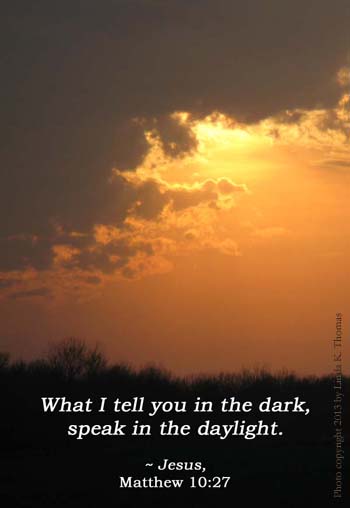
Jesus said, "What I tell you in the darkness, share with others when your daybreak appears. What I whisper into your murky shadows, shout from the rooftops when your sun rises" (Matthew 10:27).

What precious messages has God given you to share with others? 

What vignettes can you include in your memoir about God teaching you to hear Him in the dark, and to obey, and to even sing in the dark?   

Your stories are important. Someone needs to hear them. 

Make time to get started today, even if you jot down only a few words as a reminder to yourself for another day.


Saturday, April 14, 2012

Go public


Three of My Most Beloveds are suffering a type of “darkness.” Ongoing, severe pain surrounds them.


You and I have struggled in the darkness, too, for various reasons—loneliness, despair, ruin, failure, grieving.…


Yet within that darkness, God has messages for us. Within that darkness He tells you and me many things.


F.B. Meyer believed that in such times, God “tells us His secrets.”


That reminds me of God’s precious words in Isaiah 45:3, “I will give you the treasures of darkness, riches stored in secret places, so that you may know that I am the Lord…”(NIV).


God, in His goodness, fulfills divine purposes through our darkness.


Furthermore, Meyer said,


“We are not meant to always linger in the dark.…” And when the right time comes to step out of the darkness, “we are to speak and proclaim what we have learned.”


That’s one of the things we do at Spiritual Memoirs 101! Here we look back and trace the ways God used our heartaches (and our joys, too, of course) to teach us about Himself and His love and His power to help—and then we put those lessons in writing for our memoirs.


Meyer’s words will sound old fashioned to you, but they are full of inspiration:


God calls “His child to the higher altitudes of fellowship, that he may hear God speaking face to face, and bear the message to his fellows at the mountain foot.”


“Were the forty days wasted that Moses spent on the Mount, or the period spent at Horeb by Elijah, or the years spent in Arabia by Saul?


“There is no short cut to the life of faith.… We must have periods of lonely meditation and fellowship with God.… Thus alone can the sense of God’s presence become the fixed possession of the soul, enabling it to say repeatedly, with the Psalmist, ‘Thou art near, O God’ [Psalm 119:151]” (emphasis mine; F.B. Meyer, quoted by Mrs. Charles E. Cowman, Streams in the Desert).


Take a few days or weeks to look back on your dark daysyour Moses-like time on the Mount, your Elijah-like time in Horeb, your Saul-like time in Arabia—and discover that your hardships were not wasted years!


Find God’s treasures and His purposes in those difficult phases of your life. Discover the blessings that resulted.


What secrets did He whisper that you couldn’t have heard in eras of ease and seasons of sunshine? How did your life and faith change as a result?


"What God told you in the dark, speak (write) in the daylight; what He whispered in your ear, proclaim from the roofs” (Matthew 10:27), or, as Eugene Peterson worded it in The Message, “Go public.”


Think back to people who “went public,” people who shared their stories with you during your dark days.


Now it’s your turn to pass on the good deed because your kids, grandkids, great-grands, and your other readers will experience their own dark days. God can use your stories to help them. What important messages, hope, and wisdom can you share with them? Go public. Write your stories!